
Most Plastic Cloth Clips Fail Within Weeks – Why?
-
Posted by
homebud
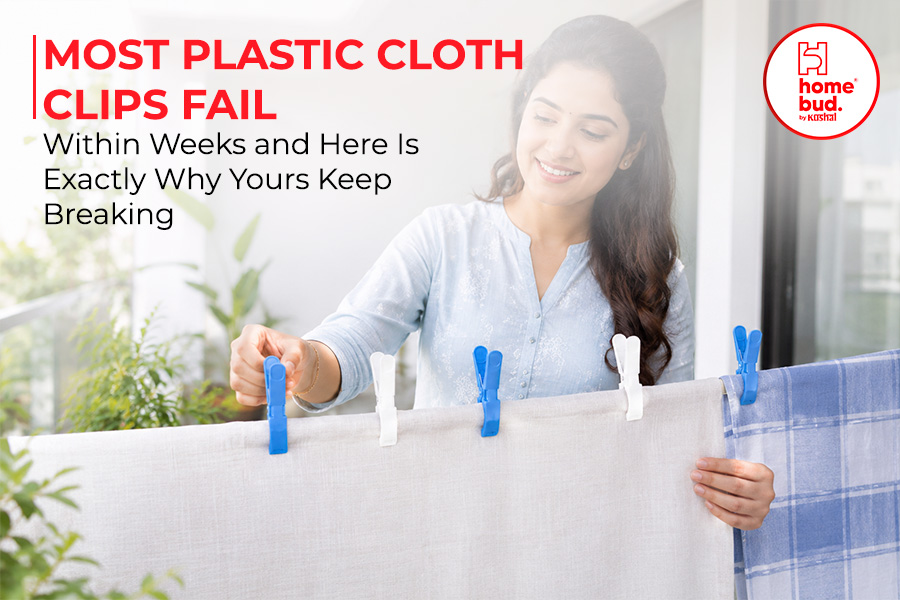
You have replaced your cloth clips three times this year. Each time you buy a new set, they look fine in the packet. They feel firm enough when you press them. You hang out the laundry and for the first few weeks everything works. Then the springs start losing tension. Then one clip snaps at the hinge on a windy morning. Then two more crack when you press them open to hang a heavy wet towel. Within two months the set is mostly broken and you are back to buying again.
This is not bad luck. It is not that you are using them wrong. It is that most plastic cloth clips available in the Indian market are built from low-grade plastic and low-tension springs that are not designed to survive the specific combination of conditions that Indian balcony laundry drying creates. Daily UV exposure from direct sunlight. Monsoon season moisture that gets into plastic hinge joints and weakens them. Temperature cycling from summer heat to rain cold that stresses cheap plastic into micro-cracks. And the daily mechanical stress of being opened, closed, and loaded with wet garments repeatedly.
Understanding what makes a plastic cloth clip genuinely durable in these conditions is what separates a set that lasts a year from a set that is broken in two months. This guide covers everything you need to know before buying your next set — the plastic materials that matter, the spring quality that determines grip longevity, the size matching that prevents both weak grip and fabric damage, and which Homebud plastic cloth clips are the right choice for your specific laundry needs.
The Plastic That Makes the Difference Between a Clip That Lasts and One That Does Not
Not all plastic is the same. This is the fact that budget cloth clip packaging never mentions and that most buyers only discover after their clips have cracked and snapped. The two plastic materials that appear most in quality cloth clips are polypropylene and ABS plastic, and the difference between them in outdoor laundry conditions is significant.
Polypropylene is a flexible, lightweight plastic with good chemical resistance. It handles repeated opening and closing well because of its flex properties and it is widely used in good quality clip construction. Under moderate outdoor conditions it performs well for extended periods. Its weakness is UV tolerance — prolonged direct sunlight exposure causes polypropylene to become progressively brittle over months of outdoor use, particularly in the intense UV conditions of Indian summers. A polypropylene clip that performs well in October may become noticeably more prone to cracking by March after six months of UV exposure.
ABS plastic is harder and more rigid than polypropylene with superior UV resistance and better tolerance of the temperature extremes that Indian balconies experience across seasons. It is more expensive to manufacture, which is why it appears in quality clips rather than budget ones. ABS maintains its structural integrity and impact resistance significantly longer under UV and temperature cycling conditions, which is why clips built from quality plastic compounds last considerably longer than their cheapest counterparts despite looking identical in product images.
The spring inside the clip is the second critical material component. A steel spring is what creates and maintains the grip force of a cloth clip. The quality of the steel determines how long the spring maintains its tension before progressively losing it. A low-grade steel spring loses significant tension within weeks of daily use and wet conditions. A quality steel spring maintains consistent grip force over hundreds of open-close cycles and extended exposure to the moisture of a laundry environment. This spring tension loss is the reason clips that grip firmly when new barely hold a tissue after two months — not the plastic cracking but the spring weakening.
The combination of quality plastic body and quality steel spring is what makes a cloth clip perform consistently over a full year of daily balcony use. This is exactly the standard that the Homebud plastic cloth clip range is built to.
Why Indian Balcony Drying Conditions Are Harder on Cloth Clips Than Most People Realise
Indian balcony laundry drying is not a gentle environment for any cleaning or laundry accessory. Understanding exactly what your cloth clips face every day helps you appreciate why quality material choice matters so much more than price per clip.
Direct sunlight exposure is the most damaging factor for plastic clip longevity. An Indian balcony facing east or west receives intense direct sunlight for four to six hours every day during summer months. During peak summer, surface temperatures on a dark plastic clip in direct sunlight can reach 50 to 60 degrees Celsius. This sustained heat softens low-grade plastic at the hinge joint where the two clip arms meet, which is why you find clips that open normally but no longer spring back with any force — the plastic at the hinge has slightly deformed under heat and the spring can no longer return it to full closed position.
Monsoon moisture creates a different problem. Water enters the hinge joint and the spring housing of a clip during rain, and if the clip is made from untreated steel and low-grade plastic, this moisture causes the spring to rust and the plastic to swell slightly at the joint. A rusted spring loses its elasticity progressively. A swollen joint creates stiffness that makes the clip harder to open and causes the plastic arms to crack under the pressure of forced opening.
Wind is the third factor. A strong balcony wind during monsoon or pre-monsoon season puts significant lateral force on a loaded clip. A clip holding a heavy wet saree in a strong wind is bearing a combination of the downward weight of the garment and the lateral force of the wind trying to pull the garment off the rope. A clip with adequate spring tension and a solid body construction holds this combination of forces. A clip with a weakened spring or a cracked body fails at exactly this moment — which is when you find your freshly washed clothes on the balcony floor or, in a high-rise, gone entirely.
The Three Homebud Plastic Cloth Clips and Exactly Which One Is Right for Your Laundry
Homebud offers three plastic cloth clip options, each engineered for a specific laundry weight range and use case. Buying the right size for your garments is as important as buying a good quality clip — a clip that is too small for the garment it is holding fails under load, and a clip that is too large can leave pressure marks on delicate fabrics.
The Homebud Cloth Clip 10 Pcs Set at Rs. 125 is the everyday standard option and the right choice for the majority of daily laundry loads. T-shirts, cotton kurtas, school uniforms, children’s clothing, light salwar sets, dupattas, undergarments, socks, and handkerchiefs all dry perfectly on a standard size clip with adequate grip and no risk of pressure marks on lighter fabrics. Rated 4.83 out of 5, it is the workhorse of the Homebud clip range. At 10 clips per set and Rs. 125 per set, it is the most practical starting pack for daily household laundry. For a household of two to three people with a standard daily laundry load, two sets of the standard clip covers all everyday drying needs.
The Homebud Biggie Cloth Clip at Rs. 165 is the step-up option built for heavier garments that the standard clip either cannot hold securely or that require a wider jaw to grip without concentrating force on a small area of thick fabric. Wet bath towels are the primary use case — a fully soaked large bath towel can weigh over 800 grams and needs a clip with both a stronger spring and a wider jaw to hold it securely on a rope without sliding. Thick cotton bedsheets, men’s denim jeans, heavy winter salwars, and thick woolen garments all belong on the Biggie clip rather than the standard. The wider jaw spreads the grip across more fabric surface which both holds heavier weights more securely and distributes the pressure to prevent jaw marks on thick fabrics. Rated 4.83 out of 5, it is the right daily-use upgrade for households with heavier laundry items in regular rotation.
The Homebud Jumbo Cloth Clip 10 Pcs Set at Rs. 140 is the heavy-duty option designed for the largest and heaviest laundry items in any Indian household. Sarees are the definitive use case. A wet silk saree can weigh over a kilogram when freshly washed, and its length means it is exposed to significantly more wind force than shorter garments. Only a jumbo clip with maximum jaw opening and the strongest spring tension holds a full wet saree securely on a balcony rope through a monsoon breeze without sliding along the rope or the clip opening under the weight. Double bedsheets, large curtains, heavy wool blankets, and thick jackets all belong on the Jumbo clip for the same reasons. Rated 4.86 out of 5, it is the highest-rated product in the Homebud clip range and the one that professional laundry management consistently relies on for heavy garments.
Matching Your Plastic Cloth Clip Size to Your Garment Weight
Using the wrong clip size for a garment weight is one of the most common reasons clips fail prematurely or leave marks on fabric. Here is the practical matching guide for the most common Indian household laundry items.
Cotton everyday wear including t-shirts, light kurtas, salwar tops, children’s school uniforms, and casual shirts all belong on the standard Homebud Cloth Clip. These garments weigh 200 to 400 grams when wet and are within the comfortable load range of the standard clip without any grip stress.
Bath towels, thick cotton kurtas, formal salwar sets, and medium-weight fabrics belong on the Biggie Cloth Clip. These garments weigh 500 to 900 grams when wet and benefit from the wider jaw and stronger spring of the Biggie that handles this weight range without the spring being pushed to its limits daily.
Sarees, double bedsheets, heavy cotton and silk dupattas used as sarees, curtains, blankets, and denim jeans belong on the Jumbo Cloth Clip. These items weigh over one kilogram when wet and need the maximum jaw opening and spring strength that only the Jumbo provides. Using a standard clip on a wet saree is why clips snap at the hinge — the clip is bearing several times the load it was designed for and eventually fails under that repeated stress.
Baby and children’s very lightweight clothing including muslin cloths, tiny socks, and infant garments are light enough for the standard clip, which provides more than adequate grip for these small, light items while being gentle enough not to leave jaw marks on delicate baby fabric.
How to Get the Longest Life from Your Plastic Cloth Clips
A quality set of plastic cloth clips maintained correctly will last through many months of daily Indian laundry conditions. Here is the care routine that extends clip life significantly beyond what most households get.
After every laundry session, do a quick check of your clips as you bring in the dry clothes. Clips that have been in direct sunlight all day on a summer afternoon are at their most warm and slightly soft. Allow them to cool before stacking them in storage, because stacking warm clips under weight can cause slight deformation at the hinge over time.
Store your clips in a dry location between laundry sessions rather than leaving them on the rope or drying rack permanently. Clips left on a wet rope in humid monsoon conditions absorb moisture into the spring housing progressively. A covered storage container or a bag that keeps the clips dry between uses significantly reduces spring rust risk.
Inspect your clips once a month for early signs of wear. A spring that opens and closes but returns with noticeably less force than when the clip was new is losing its tension. A hinge area that shows white stress marks in the plastic is developing micro-cracks. Replacing individual clips that show these signs before they fail completely means your laundry is never at risk from an unexpected clip failure on a windy day.
Rinse your clips under water occasionally if they have been used in heavy rain or after washing heavily soiled garments. This clears any detergent residue or fabric softener from the spring mechanism, which is mildly acidic and can accelerate metal corrosion over time.
Common Mistakes That Shorten the Life of Plastic Cloth Clips
These are the habits that cause most clip failures and that most households do not realise are damaging their clips until the damage is done.
Hanging clips on a single rope thread with the full garment weight concentrated at the jaw tips rather than distributed across the full jaw width. Always clip through a fold or a seam of the garment so the jaw grips a thicker, double layer of fabric rather than a single thin edge. This distributes the garment weight across a wider blade surface and reduces the stress on the spring mechanism.
Using one clip for a garment that needs two. A full wet bedsheet hung from a single clip at one corner bears all its weight at that single point. Using two clips — one at each corner — distributes the weight and means neither clip is under maximum stress. The same applies to heavy sarees, which should always be clipped at both the starting end and the pallu end to distribute the total weight between two clips.
Forcing a clip open beyond its natural maximum jaw gap. If the fabric you are trying to clip is too thick for the jaw to open around naturally, using a larger clip rather than forcing the smaller one. Forcing a clip beyond its design jaw gap strains the spring past its elastic limit, which permanently reduces its return tension.
Leaving clips in direct sunlight continuously for weeks at a time without any rest period. Clips that are used and stored alternately rather than left outdoors permanently last considerably longer because the plastic gets periods away from UV degradation between uses.
FAQ on Plastic Cloth Clips
ABS plastic with a UV-resistant compound is the most durable choice for Indian outdoor balcony conditions. It resists UV degradation better than standard polypropylene, handles the temperature extremes of Indian summers and monsoons without becoming brittle, and maintains its structural integrity at the hinge joint significantly longer under daily mechanical stress. Quality clips from Homebud are built to the material standard that Indian balcony conditions demand.
A household of two adults with daily laundry typically needs 20 to 30 clips covering a mix of standard and jumbo sizes. Adding children to the household adds 8 to 12 standard clips for children's clothing. For a household that also regularly dries sarees, bedsheets, and towels, having 10 jumbo clips and 10 biggie clips alongside 10 standard clips gives full coverage for every garment type at every weight level.
Spring tension loss is almost always caused by two factors in combination. Low-grade steel springs lose their elasticity faster under the repeated wet and dry cycling of laundry use. And clips that are regularly used on garments heavier than their design load push the spring past its elastic limit repeatedly, which accelerates tension loss. Using the correctly sized clip for each garment weight and choosing clips with quality steel springs solves both problems.
Standard clips are not the right choice for full-length wet sarees. A wet saree can weigh over one kilogram and its length means it catches significant wind force when hanging. The Jumbo Cloth Clip is specifically designed for this use case — its wider jaw opening handles the thickness of folded saree fabric and its stronger spring maintains grip under the combined weight and wind load that sarees create on a balcony drying line.
For Indian balcony conditions, quality plastic cloth clips are the most practical choice. Metal pegs rust in monsoon moisture and leave rust marks on fabric. Wooden pegs absorb moisture, swell at the joint, and develop mold in humid conditions. Quality plastic with a steel spring that is protected from direct moisture contact combines the grip strength of metal with the moisture resistance and weight advantages of plastic.
The Biggie Cloth Clip has a wider jaw than the standard clip and a stronger spring, designed for medium-heavy garments like bath towels, denim jeans, and thick cotton clothing in the 500 to 900 gram wet weight range. The Jumbo Cloth Clip has the maximum jaw opening and the strongest spring in the Homebud range, specifically designed for the heaviest laundry items — full-length sarees, double bedsheets, blankets, and curtains in the one kilogram and above wet weight range. Both are stronger than the standard clip, but for different garment weight categories.
The next time you buy plastic cloth clips, you will know exactly what you are looking for. Quality plastic that resists UV and temperature cycling. A steel spring that maintains its tension through hundreds of open-close cycles. The right jaw size for the garments you are actually hanging. And the right number of clips to cover your household’s full daily laundry load without any single clip being pushed beyond its design limits.
Browse all three Homebud plastic cloth clip options at homebud.in/product-category/cloth-clip/ and choose the right size for every garment in your laundry.