
Wet Bathroom Floor Puts Every Family Member at Risk
-
Posted by
homebud
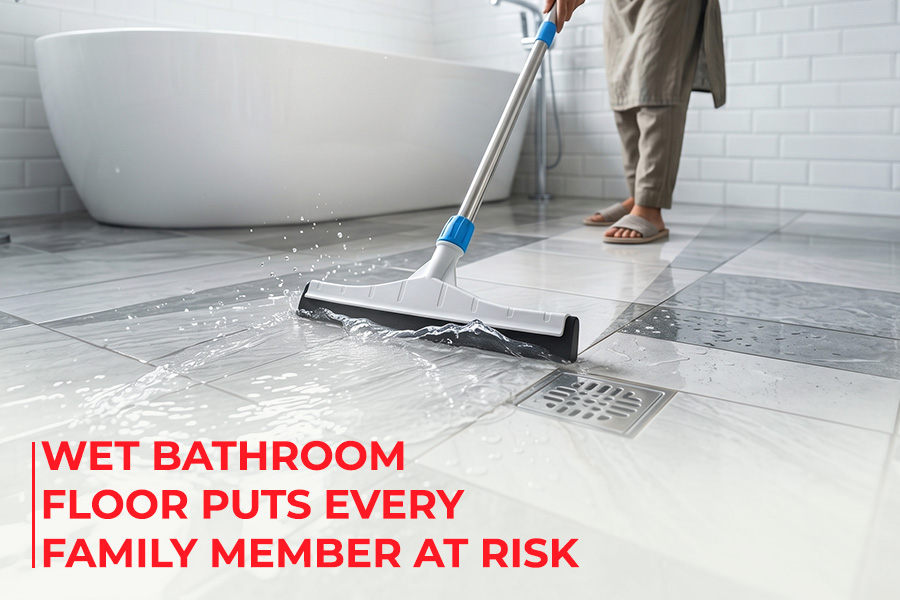
If there is one tool that every Indian bathroom genuinely needs and most bathrooms still do not have, it is a good bathroom floor wiper. Not a mop. Not a towel tossed on the floor. A proper rubber or silicone blade wiper designed specifically to push standing water off the bathroom floor and toward the drain in clean, efficient strokes.
The bathroom floor is the wettest surface in any Indian home. After every shower, every bucket bath, every splash during washing, the floor is completely covered in water. Most households wait for this water to air dry on its own, which means the floor stays wet for fifteen to thirty minutes or more after every use. A wet bathroom floor is a slip hazard for every family member who walks in during that time. It is a mold and mildew risk in the grout lines between tiles. And it creates the persistent damp smell that builds up in poorly ventilated bathrooms over time.
A bathroom floor wiper used for thirty seconds after every shower changes all of this. The floor is dry immediately. The slip risk is eliminated. The grout stays significantly cleaner. The bathroom smells fresher. It is one of those changes that once you make it, you cannot imagine how you managed without it.
This guide covers exactly what makes a bathroom floor wiper different from a standard floor wiper, how to choose between rubber and silicone blades for your specific bathroom tiles, what blade width is right for your bathroom size, and which Homebud wipers are the best choice for bathroom floor use.
Why Your Bathroom Floor Needs Its Own Dedicated Wiper
The bathroom environment is different from every other floor in the home, and those differences directly affect what makes a good wiper for bathroom use.
Indian bathrooms, particularly in apartments, are compact. The average bathroom in a standard Indian flat is between 25 and 50 square feet, with a single floor drain positioned at the lowest point of the slightly sloped floor. The entire bathroom floor becomes a wet surface after every shower or bucket bath. Water sits on every tile surface, in the grout lines between tiles, and pools in the corners and along the base of walls where the floor slope does not direct it naturally toward the drain.
A standard floor wiper sized for a kitchen or living room is often too wide to manoeuvre efficiently in a compact bathroom. A wiper that is 45 cm or wider has difficulty navigating around the toilet base, the bathroom counter, and into the corners. A bathroom floor wiper needs to be compact enough to work within the actual layout constraints of the room.
The tile surfaces in Indian bathrooms are almost universally polished or semi-polished ceramic or vitrified tile, which are smooth and non-porous. These surfaces respond best to a blade that can form a tight seal against the surface and push water cleanly rather than gliding over it. On smooth bathroom tiles, both rubber and silicone blades are effective, the choice between them depends on specific bathroom conditions.
The bathroom is also the highest-humidity environment in the home. Any cleaning tool used in the bathroom needs to be made from materials that resist moisture absorption, bacterial growth, and corrosion. A rubber or silicone blade wiper with a stainless steel or quality plastic handle is the correct material choice for daily bathroom use.
Rubber vs Silicone Blade, Which Is Better for Bathroom Floor Tiles
This is the question most buyers ask and the one that most product listings answer poorly. The honest answer is that both work well in a bathroom environment, but they have specific strengths and the right choice depends on your tile type and cleaning priority.
Rubber blade bathroom wipers are the most widely used and the most practical choice for standard Indian bathroom tiles. A firm rubber blade creates a tight, consistent seal against smooth ceramic and vitrified tile surfaces and pushes water efficiently toward the drain in clean, single strokes. Rubber handles the daily high-volume water removal after showers reliably and consistently. It is the more affordable option, widely available in the right compact sizes for bathroom use, and holds up well in the warm, humid bathroom environment.
Rubber is slightly more rigid than silicone, which means it applies more consistent pressure against the floor surface throughout each stroke. This rigidity is an advantage for water pushing on standard flat bathroom tiles. It can be a minor disadvantage on heavily textured tiles where the rigidity prevents the blade from conforming to every surface variation, on those surfaces, silicone’s flexibility performs slightly better.
Silicone blade bathroom wipers are the better choice for bathroom floors with polished marble, high-gloss vitrified tiles, or any premium stone surface where scratch prevention matters. Silicone is softer and more flexible than rubber, which means it conforms more closely to slight surface variations and creates a slightly tighter seal on very smooth surfaces. It also leaves a cleaner, more streak-free result on polished surfaces after each pass.
Silicone is naturally resistant to bacterial growth and does not develop the rubber smell that some rubber blades can produce in consistently damp environments. For bathrooms that see very frequent use and where the wiper is in contact with moisture for extended periods between cleaning sessions, silicone’s natural hygiene resistance is a practical advantage.
For the large majority of Indian bathrooms with standard ceramic or vitrified tile floors, a good quality rubber blade wiper is the right daily-use choice. For bathrooms with marble or premium polished stone floors, a silicone blade is the better investment.
Blade Width, Choosing the Right Size for Your Bathroom
Blade width is the feature that most directly determines whether a bathroom floor wiper is practical to use in your specific bathroom or whether it becomes frustrating to manoeuvre.
For compact Indian bathrooms under 35 square feet, the standard size in most 2BHK and 3BHK apartments, a blade width of 25 to 35 cm is the practical range. This size clears the floor efficiently in three to four strokes while being compact enough to navigate around the toilet base, the door, and the bathroom counter without getting stuck or requiring the wiper to be lifted and repositioned constantly. The Homebud WipeExpert Bathroom Wiper is purpose-built for this bathroom size and use case, a compact design that handles the tight geometry of a standard Indian bathroom with precision.
For medium-sized bathrooms between 35 and 60 square feet, common in larger apartments, independent houses, and master bedroom bathrooms, a blade width of 35 to 45 cm covers the floor more quickly while still being manoeuvrable in the space. The Homebud Double Blade Wiper works excellently in this size range. Its dual-blade construction pushes more water per stroke and clears a medium bathroom floor faster than a single blade wiper of the same width.
For large bathrooms above 60 square feet, found in premium apartments, independent bungalows, and master bathrooms with separate shower areas, a blade width of 45 cm or above with the efficiency of a double blade design is the right choice. The Homebud Heavy Duty 2 Blade Wiper delivers the coverage and blade force needed to clear large bathroom floor areas quickly, even when the floor is completely saturated after a shower.
Why Double Blade Wipers Are Superior for High-Use Family Bathrooms
If your bathroom is used by three or more family members every day, a single blade wiper is doing a harder job than it needs to be. A double blade wiper is a meaningful upgrade for family bathrooms that see repeated heavy water exposure.
The double blade design, two parallel rubber blades that trap and push water between them, removes significantly more water per stroke than a single blade. On a floor that is completely wet after a shower, the difference is visible immediately. A single blade wiper leaves a thin residual film that requires a second pass to collect. A double blade wiper pushes the water more completely with the first pass, leaving the floor close to dry after a single round of strokes.
For a bathroom that is cleaned five or more times a day across family members’ shower and bathing routines, the time and effort savings of a double blade wiper accumulate into a genuinely significant daily convenience. The Homebud Double Blade Wiper and the Homebud Heavy Duty 2 Blade Wiper are both built with this high-frequency family bathroom use case as their primary design purpose.
The Safety Case for Using a Bathroom Floor Wiper After Every Shower
Bathroom slips are among the most common household accidents in India, and a wet tile floor immediately after a shower is the single most consistent contributing factor. This is not a minor inconvenience risk, bathroom floor slips cause genuine injuries, particularly for elderly family members and young children who are among the most frequent bathroom users in Indian households.
A bathroom floor wiper used for thirty seconds after every shower removes the vast majority of standing water from the floor before the next person enters. The tile surface dries almost immediately after wiping, which eliminates the slip hazard as completely as any product can.
The habit is simple. After your shower, pick up the wiper, push the water from the far end of the bathroom toward the drain in three or four strokes, and hang the wiper back in its place. Thirty seconds. The floor is dry and safe for the next person. This single thirty-second habit, done consistently, is one of the most meaningful bathroom safety improvements any household can make.
How to Use a Bathroom Floor Wiper Correctly for the Best Result
Using a bathroom floor wiper correctly takes the same thirty seconds as using it incorrectly, but produces a noticeably better result. Here is the technique that professional cleaners use.
Start from the corner of the bathroom farthest from the drain and work toward the drain in overlapping strokes. Never start from the drain side and push water away from it, this scatters water into areas you have already cleared. Always work toward the drain, gathering water progressively as you go.
Use long, firm strokes that keep the blade in contact with the floor throughout the full length of each stroke. Lifting and placing the wiper in short, choppy movements reduces the seal between the blade and the tile and allows water to slip back under the blade. One long, smooth stroke is more effective than three short ones covering the same distance.
Overlap each stroke by 5 to 10 cm so no thin strip of water is left between passes. These thin strips are what cause the residual wet patches that remain after a quick wipe and that users blame on the wiper rather than on technique.
For the area directly around the toilet base and the bathroom counter base, angle the wiper head to push water out from these tight areas into the open floor space, then push it toward the drain with the regular stroke pattern.
After finishing, hold the wiper over the drain for a moment to allow the blade to drip before returning it to its storage position. Rinse the blade under the tap or shower head once a week to remove any soap residue or mineral deposits.
The Wroom Wiper Broom, When You Need Both Broom and Wiper in One
For households that want to reduce the number of cleaning tools in the bathroom to a single versatile option, the Homebud Wroom Wiper Broom is the solution. This combination tool functions as both a broom for dry sweeping and a wiper for wet floor cleaning in a single product.
In a bathroom, the Wroom handles the dry sweep of hair, dust, and debris before cleaning, and then functions as a floor wiper to push the water after mopping or showering. Two functions, one tool, one storage position. For compact bathrooms where there is limited space to store multiple cleaning implements, the Wroom is a practical and space-efficient choice that covers the full daily cleaning routine of the bathroom without requiring two separate tools.
How to Store Your Bathroom Wiper Between Uses
Proper storage is where most bathroom wiper care goes wrong. A wiper left lying on the wet bathroom floor between uses stays permanently damp, allows bacterial growth on the blade, and wears out much faster than one that is properly stored.
The correct storage method is to hang the wiper on a hook or wall-mounted holder in a ventilated position so the blade can drip dry after use. The blade should not be in contact with any surface, not the floor, not the wall, not a shelf, during storage. Contact with a surface while wet both retains moisture and gradually deforms the blade edge over time.
A simple adhesive hook rated for 1 to 2 kg on the bathroom wall near the door is sufficient for most standard bathroom wipers. The hook allows the wiper to hang with the blade pointing downward, which is the optimal drying position.
For the blade itself, rinse under running water once a week to remove soap residue and mineral deposits from hard water. If your bathroom is in a hard water area, which includes most major Indian cities, mineral deposits from water sitting on the rubber blade between uses will build up on the blade surface and reduce its effectiveness. A weekly rinse prevents this buildup and keeps the blade performing well throughout its lifespan.
Replace the blade when it shows visible cracks, thinning at the edge, or no longer seals flat against the floor surface. A blade that allows water to slip back under it rather than being pushed forward has passed its effective life and should be replaced.
Choosing Between the Four Homebud Bathroom Wipers, A Quick Decision Guide
If you are trying to decide which Homebud wiper is the right choice for your bathroom, here is the quick decision framework.
Choose the WipeExpert Bathroom Wiper if your bathroom is compact, a standard Indian apartment bathroom with limited manoeuvring space. This is the purpose-built bathroom wiper in the Homebud range, designed specifically for the size and drain layout of the typical Indian bathroom.
Choose the Double Blade Wiper if your bathroom is medium-sized and sees daily use by multiple family members. The dual-blade design removes more water per stroke, which makes it significantly faster for floors that are completely wet after every shower.
Choose the Heavy Duty 2 Blade Wiper if your bathroom is large, if you have a combined bathroom and shower area, or if your household has heavy daily use that needs a reinforced blade and handle that holds up under frequent, high-volume water removal.
Choose the Wroom Wiper Broom if you want a single tool that handles both dry sweeping and wet wiping in your bathroom, reducing the number of cleaning implements you need to store in a compact space.
Browse the complete Homebud wiper range at homebud.in/product-category/wiper/ for the full selection.
FAQ, Bathroom Floor Wiper
For a standard Indian apartment bathroom of 25 to 40 square feet, a blade width of 25 to 35 cm is the most practical choice. This size is compact enough to navigate the toilet, door, and counter layout of a small bathroom while still clearing the floor in three to four strokes. The Homebud WipeExpert Bathroom Wiper is specifically designed for this bathroom size.
For standard ceramic and vitrified tile bathroom floors, which cover the large majority of Indian bathrooms, a rubber blade is the practical everyday choice. It creates a firm seal against smooth tiles and pushes water efficiently toward the drain. For marble or high-gloss polished stone bathroom floors, a silicone blade is gentler and leaves a cleaner, streak-free finish without risking micro-scratching on the polished surface.
After every shower or bucket bath, every single time. Using the wiper consistently after every use is what delivers the safety, hygiene, and cleanliness benefits. Occasional use only partially addresses the wet floor problem. The daily habit of a thirty-second wipe after every shower is what keeps the bathroom floor dry, the grout clean, and the floor safe.
Yes, provided the blade width is appropriate for the bathroom size. A double blade wiper in a compact blade width of 30 to 35 cm is perfectly usable in a standard Indian apartment bathroom and delivers better water removal per stroke than a single blade wiper of the same width. The Homebud Double Blade Wiper is designed with blade dimensions that work in both compact and medium-sized bathroom layouts.
Rinse the blade under running water after every use to remove soap residue and floor cleaning product residue. Store the wiper hanging in a ventilated position so the blade dries completely between uses. Once a week, wash the blade with a small amount of mild dish soap and rinse thoroughly. A blade that is rinsed and dried after every use does not develop odour. The smell develops when soap residue is allowed to sit on a damp blade in a humid environment, consistent rinsing and drying prevents this entirely.
Both use a double blade construction for superior water removal per stroke. The Heavy Duty 2 Blade Wiper is built with a reinforced blade and handle designed for high-frequency heavy use, large bathrooms, commercial-use bathrooms, or households where the wiper is used many times per day. The Double Blade Wiper is the standard double blade option suited for everyday family bathroom use at a slightly lighter build weight that makes it comfortable for daily use without additional bulk.
Final Thoughts
A good bathroom floor wiper used consistently is one of the most practical hygiene and safety investments any Indian household can make. It takes thirty seconds after every shower, costs a fraction of what a single bathroom accident costs, and keeps your bathroom cleaner, drier, and fresher every single day.
Choose the right Homebud bathroom wiper for your floor size and use frequency and explore the complete range at homebud.in/product-category/wiper/.