Children’s Dress Hangers Getting Size, Grip, and Material Right
-
Posted by
homebud
A full-size adult hanger holding a toddler’s shirt looks almost comical, shoulders drooping off both ends, the whole garment sliding slowly toward one side until it ends up in a heap at the bottom of the closet. Children’s dress hangers exist specifically to fix this mismatch, but picking the right ones takes more than grabbing whatever’s labeled “kids” on the shelf. Size, grip, and how the hook handles repeated spinning in a crowded closet all matter more than most parents realize until they’ve bought the wrong set twice.
Why a standard adult hanger is the wrong tool for kids' clothes
An adult hanger’s shoulder width is built for an adult’s shoulder span, typically somewhere between 36 and 46 centimeters depending on clothing size. A child’s garment has nowhere near that shoulder width to rest on, so the fabric sags past the hanger’s natural shoulder point and stretches out of shape at the neckline over repeated use. This is the single most common reason a favorite small shirt ends up looking misshapen within a season, not washing damage, but a hanger sized for someone three times the child’s size.
It also wastes closet space in a way that’s easy to overlook. An oversized hanger takes up more horizontal rail space than the garment on it actually needs, which means fewer items fit along the same stretch of rod, a real constraint in a shared or smaller children’s wardrobe where every centimeter of hanging space counts.
Sizing childrens dress hangers to actual height, not age
The four size bands that actually matter
Children’s hanger sizing scales with height rather than a vague age bracket: hangers around 25 centimeters wide suit a child up to about 92 centimeters tall, 28 centimeters suits 92 to 116 centimeters, 30 centimeters suits 116 to 146 centimeters, and from 146 centimeters upward a child is generally better served by a hanger closer to 36 centimeters, edging toward adult sizing. Matching the hanger width to the child’s actual height, rather than their age in years, accounts for the wide variation in how tall kids of the same age can be.
Why “age-based” sizing on packaging is a rough guide at best
Packaging that says “ages 2 to 5” is estimating an average, but a tall three-year-old and a smaller five-year-old can need noticeably different hanger widths despite both falling in that labeled range. Checking a garment’s own shoulder width against the hanger’s width, rather than trusting the age label alone, catches this gap before a batch of new hangers turns out to be the wrong size for half the wardrobe.
What slip-resistant and anti-skid features are actually solving
Shoulder garments tops, dresses, jackets
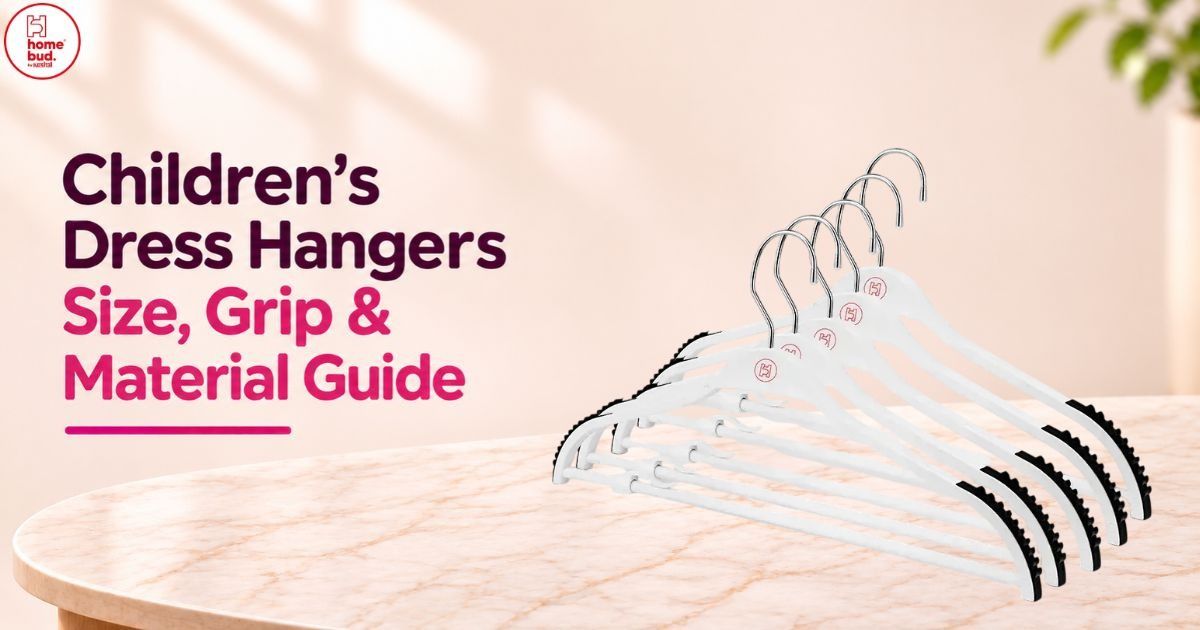
A smooth plastic shoulder gives a lightweight knit top almost nothing to grip, which is why it slides off so easily compared to a textured or notched surface. Slip-resistant arms work by adding friction at exactly the point where fabric rests, holding a shoulder seam in place rather than letting gravity and a smooth surface slowly walk the garment toward one end. The Kids Hanger set builds this in directly, pairing a compact shoulder width for smaller clothes with a smooth finish gentle enough for delicate fabric.
Clipped garments trousers, skirts, dupattas
Anything without shoulders, trousers, skirts, and in Indian households specifically dupattas and sarees, needs a different mechanism entirely: a clip rather than a shoulder shape. Built-in clips solve this by gripping the waistband or fabric edge directly rather than relying on friction against a bare shoulder bar, which is also why a single hanger design rarely covers both shoulder garments and clipped ones well. A set that includes both hanger types, rather than assuming one shape fits every garment in a child’s wardrobe, avoids leaving half the closet without a proper hanging option.
Rotating hooks and why they matter more in a kid's closet
A fixed hook forces every hanger to face the same direction, which in a narrow children’s closet section often means constantly re-angling hangers by hand just to see what’s hanging. A 360-degree rotating hook lets each hanger turn freely, so a child, or a parent moving quickly through a morning routine, can see and grab a specific item without untangling a row of fixed-facing hangers first. This matters more in kids’ closets specifically because the rail segment is usually shorter and more crowded relative to how many small items get hung on it.
It also matters for a child learning to dress themselves. A rotating hook that turns easily at a light touch lets even a young child pull an item free without yanking the whole rail or knocking neighboring hangers loose, a small detail that makes a morning routine smoother for both the child and whoever’s supervising it.
Matching hanger count to how fast kids' wardrobes turn over
Children’s wardrobes churn through sizes fast enough that buying too many hangers for a single size range often means half the set sits unused within a year. Buying in smaller batches of five, like the Dynamic Hanger Set, which pairs five kids’ hangers with five of the dual-purpose Dynamic style for trousers and clipped garments, tends to match actual turnover better than committing to a large set all at once. For sturdier, higher-capacity needs as a child grows into bigger clothes, the Legend Hanger Set and Ultimate Hanger 10-piece set scale up from there. And since kids’ clothes air-dry on the line as often as they hang in a closet, pairing hangers with sturdy cloth clips covers the laundry side of the same wardrobe.
Frequently asked questions
Match the hanger width to your child's height rather than their age. Roughly 25 centimeters suits a child up to 92 centimeters tall, 28 centimeters suits 92 to 116 centimeters, and 30 centimeters suits 116 to 146 centimeters. Checking a garment's own shoulder width against the hanger is a reliable backup if you're unsure which band your child falls into.
This is almost always a grip or size mismatch. A smooth-surfaced hanger gives a lightweight garment little to hold onto, and a hanger that's too wide for the shoulder lets fabric slide toward the lower, drooping end. A slip-resistant or notched hanger shoulder, sized correctly for the garment, solves both issues at once.
Plastic hangers are generally fine for everyday children's wear, lightweight, affordable, and easy to wipe clean, though they're less durable over the long run than wood and can let slippery fabric slide more easily if the surface isn't textured. For delicate or slippery fabric specifically, a notched or slip-resistant design matters more than the base material itself.
Generally yes. Shoulder-style hangers work for tops, dresses, and jackets that have a natural shoulder line to rest on, while trousers, skirts, and wrap-style garments like dupattas need a clip mechanism to stay secured. A set that includes both hanger types covers a child's full wardrobe rather than leaving clipped garments without a proper option.
A rotating hook lets the hanger turn freely on the rail instead of staying fixed in one direction, which makes it easier to see and grab items in a crowded or narrow closet section without manually re-angling each hanger. This matters more for kids' closets, where rail space is often shorter relative to how many small items get hung.
Smaller sets, five or so at a time, usually suit how quickly kids grow out of a given clothing size better than committing to a large set upfront, since buying in bulk for one size range often means a chunk sits unused within the year. Scaling up to a larger set makes more sense once a child's wardrobe stabilizes in a size range for a longer stretch.
Most lightweight plastic children's hangers travel reasonably well since they're compact and don't add much weight to luggage, though a slip-resistant or clip-style option is worth prioritizing for travel specifically, since clothes shift around more in transit than they do sitting in a stationary closet.