
Home Cleaning Kit Essentials What Actually Belongs in One
-
Posted by
homebud
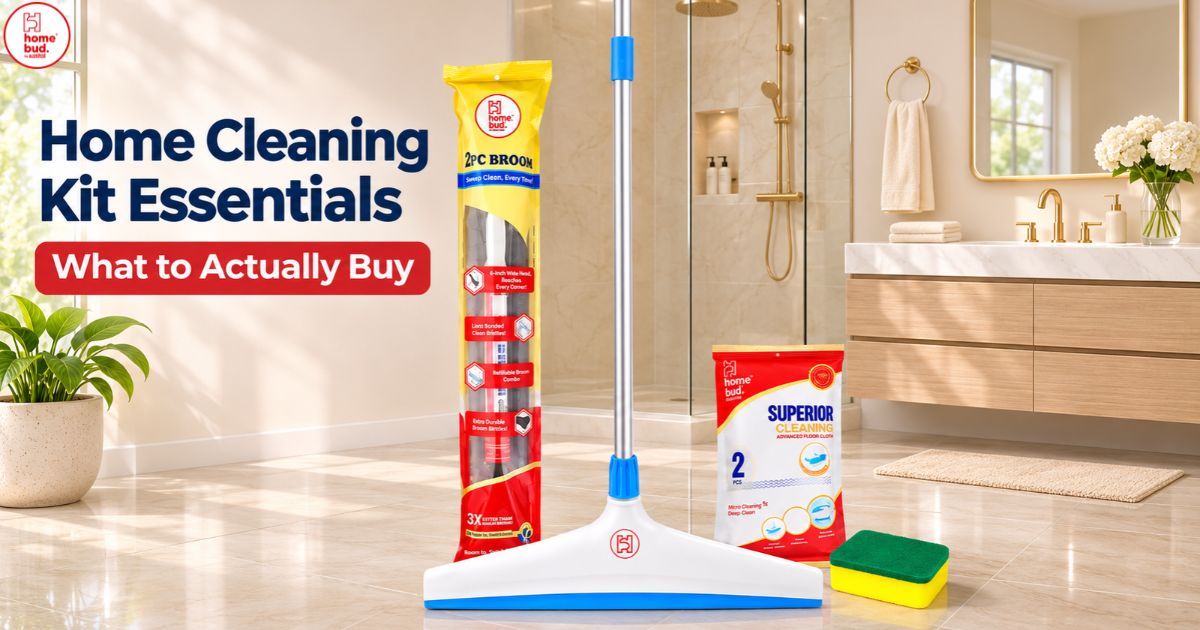
Buy a “complete” cleaning kit online and you’ll often get six items, half of which duplicate each other and one that never leaves the box. Figuring out home cleaning kit essentials isn’t about collecting more tools. It’s about covering the handful of jobs every home actually repeats: dry sweeping, wet wiping, scrubbing, and the occasional dusting pass that gets skipped more than it should.
What a cleaning kit is actually solving for
Most homes do best with two or three tools that cover dry mess, wet mess, and stuck-on mess, used often enough that reaching for them becomes automatic rather than a chore, rather than a cupboard full of specialty gadgets that rarely get touched. A kit that tries to do everything usually means half the pieces sit unused, while a kit that’s too narrow leaves gaps that get filled with whatever’s nearby, a bath towel used as a mop, a kitchen rag doing floor duty.
The core tools that belong in every kit
A broom that handles both dry sweeping and fine dust
A standard broom clears visible debris, hair, crumbs, leaves tracked in from outside, but it’s the fine dust left behind that most brooms miss. Look for one with a dense, fine bristle row alongside the main sweep, since that combination catches what a single-texture broom leaves behind on tile and stone floors.
A wiper for the wet pass most people skip
Sweeping alone leaves a thin film of dust that only shows up once the light hits the floor at an angle. A floor wiper, used right after sweeping rather than as a separate chore, picks up that residue and handles spills immediately rather than letting them dry into a mark. Households that skip this step tend to notice their floors never look as clean as they expect, even right after sweeping.
Something for scrubbing that isn’t your dish sponge
Dish sponges and all-purpose scrubbers are not interchangeable, even though a lot of kitchens treat them that way. A dedicated scrubber for utensils and hard surfaces avoids cross-contaminating food-contact items with whatever was last cleaned off a counter or stovetop, and it holds up to harder scrubbing without falling apart the way a soft dish sponge does.
Quick cleanup vs. full reset picking the right scope
Not every day calls for the same kit. The real difference between a quick kit and a fuller one usually comes down to two things: how wide a mess you’re dealing with, and how much time you actually have before guests or a deadline arrive. A kit sized for a five-minute tidy rarely holds up for a weekend-long deep clean, and the reverse is just as true, a heavy-duty kit for a daily five-minute pass is more tool than most days call for.
When a lighter kit is enough
A fast post-meal or post-festival cleanup, crumbs on the floor, a quick wipe-down, a utensil or two that needs scrubbing, doesn’t need a wide broom or a dedicated duster. A compact kit covering sweeping, wiping, and basic scrubbing handles this in a few minutes, and keeping it light means it’s actually quick to grab rather than something you have to assemble.
When you need the wider, heavier-duty version
A full house reset, after a renovation, a large gathering, or just a long-overdue deep clean, calls for a wider broom that covers more floor per pass, a combination tool that switches between sweeping and wiping without a tool change, and a duster for surfaces a floor-focused kit never reaches. HomeBud’s Total Home Cleaning Kit is built around exactly that gap: a wider broom, a 2-in-1 broom-and-wiper combo, and a duster bundled so the wider job doesn’t mean assembling four separate purchases.
What people usually leave out of a kit
Dusters are the most commonly skipped piece, mostly because dust on shelves and furniture is less visually obvious than dust on a floor until it’s built up for weeks. A kit without one tends to handle floors well while everything above knee height goes untouched for far longer than anyone intends. If your current setup is floor-only, a duster from the floor-duster range closes that gap without needing a separate shopping trip.
The second most common gap is having only one wiper for the whole house, bathroom and kitchen floors see very different kinds of mess, soap residue and standing water versus food spills and grease, and a single all-purpose wiper compromises on both. Checking the wiper category for a blade type suited to each room is a small step that saves a lot of repeated scrubbing later.
Buying a bundled kit versus assembling your own
A pre-assembled kit saves the step of researching each tool separately, and it usually works out cheaper than buying the same pieces individually. HomeBud’s Quick Home Cleaning Kit bundles a broom, a floor wiper, and a kitchen scrubber sponge for exactly the fast, everyday version of this job, while the combo options under the broom and wiper combo range suit anyone who wants the core two tools without the full kit’s extra pieces.
Building your own kit from individual purchases makes more sense if you already own one or two of the pieces and just need to fill a specific gap, a duster, say, or a second wiper for a different room. For a first-time setup, though, a bundled kit is usually the faster and cheaper route to covering the basics in one purchase.
Frequently asked questions
At a minimum, a broom for dry sweeping, a floor wiper for the wet pass, and a dedicated scrubber for utensils and surfaces. These three cover the bulk of daily cleaning. Everything else, dusters, specialty brushes, wider combo tools, addresses specific gaps rather than being essential for every household.
It depends on storage space and how often you clean. A combo tool saves a step during cleaning and takes up less storage room, which matters in smaller homes. Separate tools can be more specialized for their individual job, but for most daily use, a well-made combo covers both tasks without a meaningful drop in performance.
Bristles on a broom typically need replacing once they visibly splay or thin out, usually somewhere between six months and a year with daily use. Wiper blades wear faster if used on rough or textured floors. Checking bristle and blade condition every few months is a better guide than following a fixed calendar.
This usually means the sweeping step is missing fine dust rather than just visible debris, or the wiping step is spreading a diluted layer of grime rather than lifting it. Switching to a broom with a finer bristle row for the final pass, and wiping with a clean, wrung blade rather than a soaked one, usually fixes this.
Generally yes, at least for wipers and scrubbers. Kitchen messes involve grease and food residue that respond better to a firmer scrubber, while bathroom floors deal with soap scum and standing water that a softer wiper blade handles without scratching tile. Using one tool for both usually means it’s suited to neither.
For most small apartments with light daily mess, yes. A quick kit covering sweeping, wiping, and scrubbing handles routine cleanup well. It’s worth upgrading to a fuller kit only if you’re dealing with pets, frequent guests, or rooms with carpet and upholstery that need more specialized attention.
A quick kit is built for speed and covers the three daily basics in a compact form. A total kit adds width and reach, a wider broom for faster floor coverage, a combo tool, and a duster for surfaces beyond the floor, aimed at less frequent but more thorough cleaning sessions rather than daily touch-ups.