
Bathroom Wiper That Clears Water From Any Floor Very Fast
-
Posted by
homebud
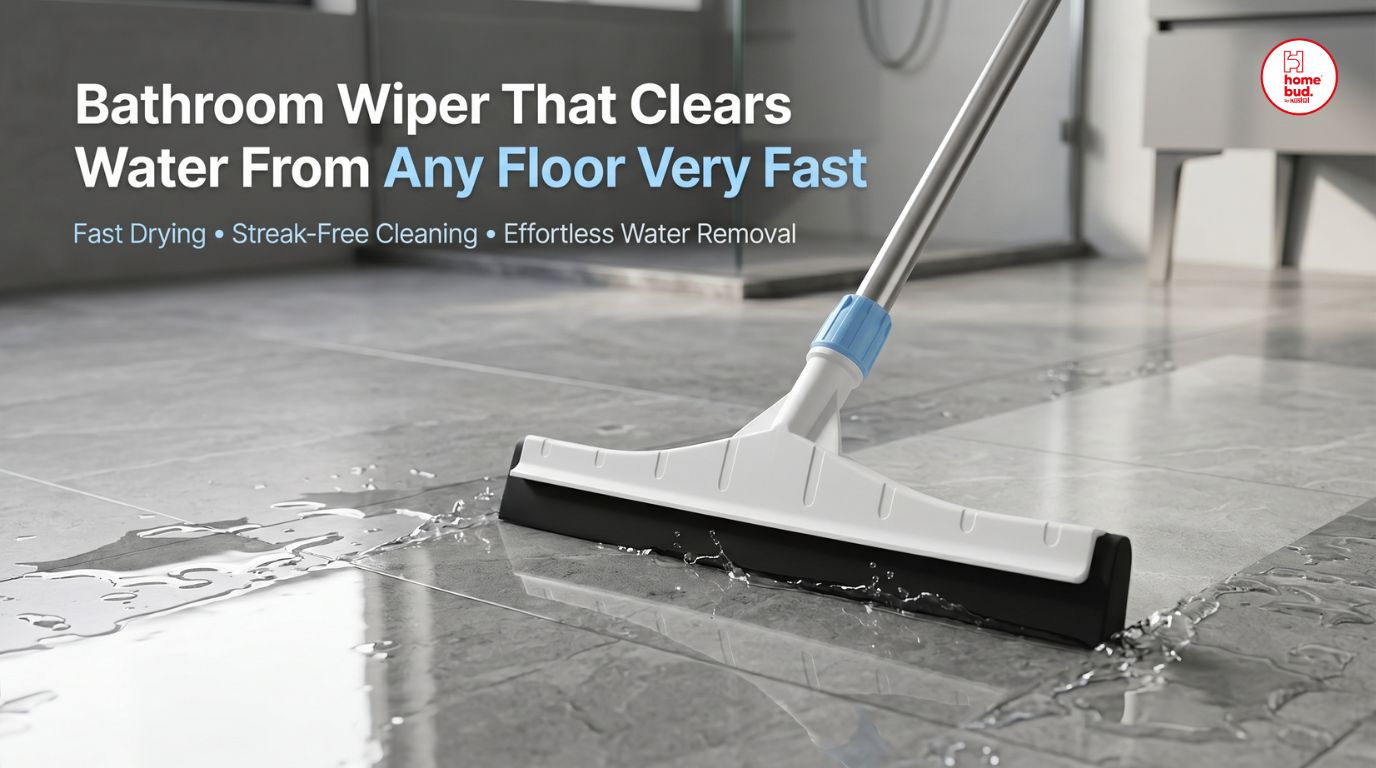
Every Indian bathroom floor is a wet floor at least three to five times a day. After the morning shower. After the afternoon bath. After the evening wash. After mopping. After every bucket fill that splashes across the tiles. A bathroom wiper is the one tool that turns a wet, slippery, damp-smelling bathroom floor into a dry, safe, clean surface in under thirty seconds — every single time.
Most households do not own a dedicated bathroom wiper. They let the floor air dry, toss a towel down, or use the same mop that cleaned the floor to absorb the residual water. None of these methods works as well or as quickly as a rubber blade wiper that physically pushes standing water toward the drain in three to four smooth strokes. A wiper does not wait. It does not absorb and retain moisture the way a cloth does. It displaces water completely and immediately, leaving behind a surface that is dry enough to walk on before you have even put the wiper back on its hook.
Why a Wet Bathroom Floor Is a More Serious Problem Than Most Households Treat It
A wet bathroom floor immediately after a shower is treated as a normal condition in most Indian homes. It is normal in the sense that it happens every day. It is not normal in the sense that it is acceptable or safe.
Wet ceramic and vitrified tile bathroom floors are among the most common sites of household slip-and-fall accidents in India. The same tile surface that is perfectly safe to walk on when dry becomes a significant slip hazard within seconds of a shower because the thin water film on the tile surface eliminates the friction between the foot and the tile glaze. Children running into the bathroom, elderly family members entering for their morning routine, or any family member in a hurry moving across a wet tile floor face a real fall risk every time the floor has not been properly dried.
The hygiene dimension of a persistently wet bathroom floor is equally significant. Moisture sitting in tile grout lines for ten to fifteen minutes after every shower provides the exact conditions that mold and mildew require to establish and spread. Bathroom grout that is never fully dried between uses develops the dark staining and musty smell that becomes progressively harder to remove the longer it builds. A bathroom wiper used consistently after every shower eliminates this persistent moisture from the grout surface before mold has time to establish, which is far easier than attempting to remove established mold staining from grout later.
Hard water mineral deposits are the third dimension. In most Indian cities with hard tap water, the droplets that remain on the bathroom floor after a shower deposit dissolved minerals as they evaporate. These deposits accumulate over days and weeks into the white, chalky scale that dulls tile surfaces and collects in grout lines. A bathroom wiper that removes the water before it evaporates removes the mineral deposit problem at the source. No standing water means no evaporation and no mineral scale accumulation.
How a Rubber Blade Bathroom Wiper Works and Why It Outperforms Every Alternative
The mechanism of a rubber blade wiper is simple and physically efficient in a way that no cloth, mop, or towel alternative can match for the specific task of clearing standing water from a tile floor.
The rubber blade creates a seal with the smooth tile surface when held at a slight forward angle and pushed across the floor. This seal prevents water from slipping under the blade as it is pushed forward. The water accumulates ahead of the blade as a concentrated pool that is directed toward the drain at the end of each stroke. The blade never saturates because it never absorbs. Every stroke is as effective as the first regardless of how much water was on the floor. And the floor surface is left genuinely dry after the final stroke rather than damp from the residual moisture that a cloth leaves in its fibres as it is moved across the surface.
A towel or cloth on a wet bathroom floor absorbs water from the contact points between the cloth and the floor but leaves the areas between contact points untouched. A rubber blade wiper maintains a continuous seal across its full width throughout the stroke and clears the entire path behind it in a single pass. The physics of displacement versus absorption is the fundamental reason a wiper outperforms a cloth for this specific task.
1. Homebud Double Blade Wiper — Best Everyday Bathroom Wiper for Indian Homes
The Homebud Double Blade Wiper at Rs. 285 is the everyday bathroom floor wiper for standard Indian apartment bathrooms. The curved rubber edge design maintains blade contact across the slight surface variations of standard ceramic and vitrified tile floors — the minor height differences between adjacent tiles and the slight recesses of grout lines — ensuring each stroke clears water completely rather than bridging over these variations and leaving residual pools behind.
The dual blade construction removes more water per stroke than a single blade wiper. The front blade gathers water forward and the rear blade pushes it as a concentrated stream toward the drain. For a bathroom that is used by three or more family members daily and that sees significant water volume on the floor after every shower, the dual blade efficiency means the bathroom floor is cleared in fewer strokes and dries faster between uses.
Designed specifically for wet bathroom surfaces, the Double Blade Wiper handles the daily bathroom floor drying routine efficiently at Rs. 285 with free shipping. For most Indian households with a standard apartment bathroom, this is the right starting point for a daily bathroom wiper purchase.
2. Homebud Heavy Duty 2 Blade Wiper — Best for Large Bathrooms and High-Use Households
The Heavy Duty 2 Blade Wiper at Rs. 425 is the reinforced bathroom wiper for households where the bathroom sees four or more users daily, where the bathroom floor area is above 50 square feet, or where the wiper is used multiple times per day across bathroom and kitchen floors. It dries surfaces in a single glide for clean, streak-free floors — a design standard that requires both a higher-quality blade material and a more robust handle construction than a standard everyday wiper.
The heavy-duty blade construction maintains its seal quality and water removal efficiency over significantly more daily use cycles than a standard wiper before the blade edge begins to lose its sharpness and allow water to slip under the seal. For households where the bathroom wiper is used five or more times daily across multiple family members’ bathing routines, the heavy-duty specification is the practical match for the actual use intensity rather than a standard wiper that will need replacement faster because it is being used beyond its design load.
Rated 4.71 out of 5, the Heavy Duty 2 Blade Wiper is the investment for any household that has experienced a standard bathroom wiper wearing out quickly under heavy daily use and wants the version that holds up properly under that demand.
3. Homebud WipeExpert Bathroom Wiper — Best for Compact Indian Bathrooms
The WipeExpert Bathroom Wiper is purpose-built for the compact bathroom dimensions that characterise the large majority of Indian apartment bathrooms. Standard Indian apartments in 2BHK and 3BHK configurations have bathrooms of 25 to 40 square feet where manoeuvring a wide wiper around the toilet base, the bathroom counter, and into corners requires a more compact and precise tool than a standard full-size wiper.
The WipeExpert’s design is calibrated for this specific use case — a bathroom wiper that is compact enough to navigate the tight geometry of a standard Indian bathroom without requiring constant repositioning, while still clearing the floor efficiently in three to four strokes. For households where the bathroom wiper needs to work in a space where every movement has a wall, a toilet, or a fitting nearby, the WipeExpert delivers the precision of a purpose-built bathroom wiper rather than a general floor wiper adapted to a compact space.
4. Homebud Kitchen Wiper — Best for Counter and Spill Cleanup Beyond the Bathroom
The Kitchen Wiper at Rs. 90 is the compact handheld bathroom and kitchen wiper for counter-height surfaces — the kitchen slab, the bathroom vanity counter, the sink surround, and any smooth horizontal surface where water accumulates and needs to be cleared quickly without a full floor wiper setup.
Compact and efficient for countertops and surfaces with a premium rubber lip that ensures streak-free cleaning, the Kitchen Wiper is the quick-access tool for the micro-cleaning moments that happen multiple times a day in every Indian home. After washing hands at the bathroom sink and water splashes across the vanity counter. After rinsing the bathroom bucket and water spreads across the floor around the tap. After a kitchen spill that needs immediate clearing before it reaches the edge of the counter.
At Rs. 90 with free shipping, the Kitchen Wiper lives beside the sink and is ready to use in two seconds without bringing a full floor wiper into the situation. For households that want a dedicated tool for counter surfaces alongside their floor wiper, the Kitchen Wiper is the complement that covers every surface type in the bathroom and kitchen.
Choosing the Right Bathroom Wiper for Your Specific Bathroom
The right bathroom wiper for your home depends on four practical variables.
Bathroom size determines the blade width you need. A compact bathroom under 35 square feet is best served by a compact purpose-built bathroom wiper like the WipeExpert that navigates the tight space efficiently. A medium bathroom of 35 to 60 square feet works well with the Double Blade Wiper. A large bathroom above 60 square feet benefits from the Heavy Duty 2 Blade Wiper which covers the larger area faster and handles the higher water volume more efficiently.
Daily use frequency determines the wiper durability grade you need. One to two users daily — standard Double Blade Wiper. Three to four users daily — Double Blade Wiper or WipeExpert depending on size. Five or more users daily or a guesthouse or commercial bathroom — Heavy Duty 2 Blade Wiper.
Tool consolidation preference determines whether the Wroom is the better choice. If you want one tool that sweeps and wipes, the Wroom handles both functions with the stainless steel handle durability that makes it a long-term single-tool investment. If you already have a broom and want a dedicated wiper, any of the single-function wipers is the right choice.
Counter surface cleaning need determines whether the Kitchen Wiper is worth adding alongside the floor wiper. For households where the bathroom vanity counter or kitchen slab accumulates water daily and needs a dedicated counter wiper, the Kitchen Wiper at Rs. 90 is the most accessible and most practical answer.
How to Maintain Your Bathroom Wiper for Maximum Performance Life
Rinse the blade under the shower or tap immediately after every use. This removes cleaning solution, soap residue, and any biological material from the blade surface before it dries onto the rubber. A blade that is rinsed after every use maintains its clean seal surface for significantly longer than one where residue is allowed to dry and accumulate.
Once a week, wash the blade with a small amount of mild liquid soap, rinse thoroughly, and allow to fully air dry before the next use. A weekly wash removes the accumulated surface film that regular rinsing does not fully clear and keeps the blade hygienic throughout its service life.
Inspect the blade edge every month for cracks, thinning, or sections where the blade has lost its flat profile. A blade that no longer seals flat against the floor surface in any section will allow water to pass under the blade at that point with every stroke, leaving damp patches in the corresponding floor position after each use. Replace the blade or the wiper when this condition develops rather than continuing to use an ineffective tool that requires double the strokes to produce a worse result.
FAQ on Bathroom Wiper
The WipeExpert Bathroom Wiper is purpose-built for compact Indian apartment bathroom dimensions. Its compact blade width and precise design navigates the tight space around the toilet, bathroom counter, and fittings efficiently while still clearing the bathroom floor in three to four strokes. For a standard 2BHK or 3BHK apartment bathroom, the WipeExpert is the most practical purpose-matched choice.
For a compact bathroom of 25 to 40 square feet after a standard shower, four to six overlapping strokes from the far wall to the drain clears the main floor area. The corner and wall base passes add two to four additional short strokes. A complete bathroom floor wipe using correct technique takes approximately thirty seconds in a standard Indian apartment bathroom.
For standard ceramic and vitrified tile bathroom floors, a rubber blade is the practical everyday choice. It creates a firm seal against smooth tile and pushes water efficiently toward the drain. Silicone is slightly softer and produces a marginally cleaner finish on very high-gloss polished surfaces but the practical performance difference in a standard tile bathroom is small. For marble bathroom floors where scratch prevention is a priority, a silicone blade is the more careful choice.
You can use the same wiper across both surfaces if the blade is rinsed between uses. Many households prefer keeping a dedicated bathroom wiper for hygiene reasons — bathroom floor biological residue should not be transferred to the kitchen floor surface where food preparation happens. A dedicated wiper per room is the more hygienic approach.