
Sponge for Scrubbing That Lathers Well and Cleans Every Surface
-
Posted by
homebud
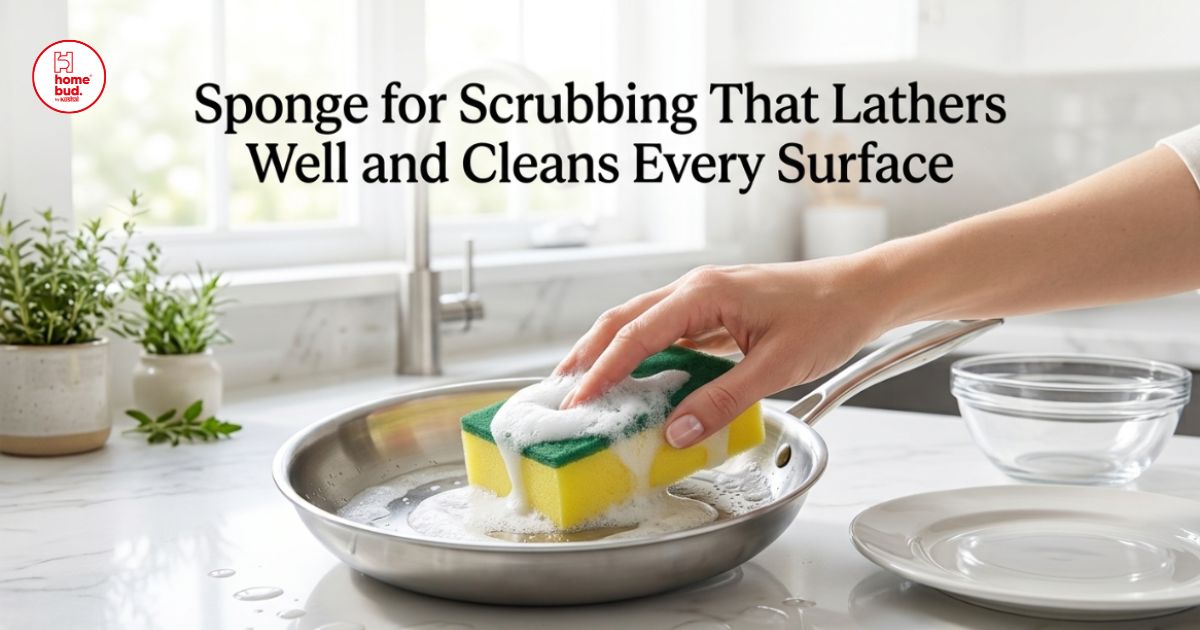
Pick up your current kitchen sponge and squeeze it. If it compresses flat and barely springs back, if it releases a thin grey foam that smells faintly sour, if the scrub surface has gone smooth and rounded rather than staying textured and abrasive — that sponge is not cleaning your dishes. It is spreading a thin film of accumulated residue across them while you believe you are washing them clean.
A sponge for scrubbing that actually works does three things consistently throughout its useful life. It generates rich, consistent lather from a small amount of dish soap rather than depleting its soap in the first few seconds of contact with a vessel. It maintains its structural thickness and scrub surface texture over weeks of daily use rather than compressing flat and going smooth within days. And it cleans through the right combination of lather chemistry and surface abrasion matched to the vessel and the cleaning task — gentle where the surface needs gentle, firm where the deposit needs firm.
What Makes a Scrubbing Sponge Worth Buying
Most buyers choose a kitchen sponge based on price without knowing the functional criteria that determine whether it actually performs well or merely simulates performance for the first few days before deteriorating into a useless compressed pad. Here is what actually matters.
Foam density determines both lather generation and structural longevity. A dense foam core retains more soap and water within its structure during washing, which means it releases consistent, rich lather throughout the washing session rather than depleting in the first vessel. Dense foam also resists compression — it maintains its original thickness over more washing cycles before reaching the flat, floppy stage that standard thin sponges reach within two weeks of daily use. A sponge that is still firm and thick after three weeks of use is still performing. One that has compressed to half its original thickness within a week was built from low-density foam that was never going to last.
Scrub surface quality determines how effectively the sponge removes food residue that dish soap alone cannot lift. The scrub layer needs to be firm enough to generate abrasive friction against the vessel surface but calibrated to the right level of firmness for the surfaces it is used on. A scrub surface that is too aggressive scratches standard vessel surfaces. A scrub surface that is too soft provides almost no additional cleaning force beyond the soft foam side. The calibration of scrub firmness to cleaning effectiveness without surface damage is the quality parameter that separates a well-designed scrubbing sponge from both a too-soft and a too-harsh alternative.
Absorbency determines how the sponge handles water and soap throughout the washing session. High absorbency means the sponge holds the water-soap mixture within its structure and releases it gradually against the vessel surface in a smooth, controlled cleaning contact. Low absorbency means the sponge surface is immediately saturated and the excess water-soap mixture runs off onto the counter and down the drain rather than staying in contact with the vessel surface where it does the cleaning work.
Durability is the practical measure that most buyers only appreciate over time. A sponge that costs Rs. 30 and needs to be replaced every ten days costs significantly more over a year than a sponge that costs Rs. 60 and lasts four weeks with proper care. The true cost of a kitchen sponge is the cost per effective cleaning day, not the purchase price.
1. Homebud Kitchen Scrub Sponge — Best for Gentle Daily Dishwashing
The Kitchen Scrub Sponge at Rs. 50 is the everyday gentle scrubbing sponge for the daily dishwashing load of the standard Indian kitchen. Soft yet effective for removing grease and stains, gentle on hands and safe for delicate cookware, and long-lasting in its sponge design for everyday dishwashing — these are the properties that make it the right tool for the vessels that make up the majority of a daily washing load.
Plates, steel bowls, glasses, serving spoons, ladles, small containers, and everyday cooking vessels with standard food residue from dal, sabzi, rice, and curry all belong on the Kitchen Scrub Sponge. The soft foam generates excellent lather and covers the vessel surface smoothly, lifting everyday food residue through soap chemistry rather than abrasion. The result is clean vessels without any risk of surface damage from the cleaning tool itself.
The soft construction is most critically important for non-stick cookware. The Teflon and ceramic coatings on non-stick tawas and kadais scratch from abrasive contact — even the scrub side of a dual-sided sponge causes micro-scratching on these coatings with repeated use. The Kitchen Scrub Sponge’s soft construction is safe for non-stick surfaces throughout its entire service life. For any household with non-stick cookware, the Kitchen Scrub Sponge is the only scrubbing tool that should contact these surfaces.
Gentle on hands is a property that matters more in the context of three daily dishwashing sessions than it does for an occasional washing task. A sponge that is comfortable to hold and use for five minutes at a time, multiple times daily, is one that gets used properly and thoroughly rather than abandoned partway through the task because the hand fatigue from a stiff, uncomfortable sponge makes completing the wash an unpleasant effort. The Kitchen Scrub Sponge’s soft foam is comfortable in the hand for extended washing sessions without the stiffness that makes an overly firm scrubber tiring over longer use.
At Rs. 50 and rated 4.43 out of 5, the Kitchen Scrub Sponge is the accessible everyday scrubbing sponge that covers the majority of daily dishwashing needs at the most affordable price point in the Homebud range.
2. Homebud Sandwich Sponge Scrub — Best for Versatile Heavy-Duty Scrubbing
The Sandwich Sponge Scrub at Rs. 60 is the three-layer construction scrubbing sponge that handles the full range of cleaning intensity from gentle surface wiping to moderate abrasive scrubbing in a single tool. Crafted with 3 powerful layers for deep, effective cleaning, it holds froth inside to prevent mess and maximise detergent use while being gentle on hands and tough on stubborn grease and stains.
The three-layer construction is the defining feature that makes this sponge genuinely different from a standard two-sided sponge. The soft foam outer layer handles gentle vessel cleaning identically to the Kitchen Scrub Sponge, covering non-stick surfaces, glass, and delicate cookware safely. The dense foam middle core is the layer that most directly determines lather performance and structural longevity — its thickness retains significantly more dish soap within the sponge structure than a thin two-sided sponge core, generating richer, more consistent lather throughout the washing session and maintaining the sponge’s three-dimensional form for weeks rather than compressing flat within days.
The abrasive scrub outer layer provides the controlled friction needed for vessel surfaces with dried masala residue, oil film from deep frying, light staining from haldi and masalas, and any food deposit that the soft foam side cannot lift without additional abrasive contact. This layer is calibrated for effective scrubbing on steel and aluminium vessel surfaces without being aggressive enough to damage standard metal cookware finishes under normal hand pressure.
The froth retention property of the dense middle core is the practical benefit that most users notice most immediately after switching from a standard thin sponge. The froth that forms from dish soap in the middle core of the Sandwich Sponge Scrub stays within the sponge structure and is released gradually against the vessel surface throughout the washing session, maintaining consistent cleaning performance from first stroke to last. A thin sponge saturates with water and depletes its soap in the first few seconds of contact, requiring constant reloading with dish soap to maintain lather. The Sandwich Sponge Scrub’s froth retention means fewer soap applications per washing session and better cleaning performance throughout.
At Rs. 60 and rated 4.29 out of 5, the Sandwich Sponge Scrub is the versatile choice for kitchens that produce a mix of everyday food residue and moderate cooking deposits across steel, aluminium, and ceramic vessels — covering most Indian kitchen cleaning intensity levels in a single two-sided tool.
3. Homebud Stainless Steel Scrubber 2 Pcs — Best for Heavy Burnt Deposits
The Stainless Steel Scrubber 2 Pcs at Rs. 50 is not technically a sponge but is the scrubbing tool that completes the Homebud kitchen cleaning system for the cleaning jobs that no foam sponge can handle. Heavy-duty steel for tough burnt deposits and stubborn grime, rust-resistant and long-lasting for everyday kitchen cleaning, tough on stains and safe for the appropriate utensil types.
For burnt dal on the pressure cooker base, carbonised masala on the steel kadai, baked-on oil film on the iron cookware, and mineral scale on the stainless steel sink, the steel scrubber generates the abrasive force that breaks through carbonised food bonds with metal surfaces. No foam sponge, regardless of how firm its scrub surface is, creates the contact force per square millimetre that a dense steel wire mesh generates. For these heavy deposits on hard metal surfaces, the steel scrubber is the correct tool and the foam sponge is not.
The surface restriction for the steel scrubber is absolute and non-negotiable. It should never contact non-stick, Teflon, ceramic-coated, glass, glazed ceramic, or uncoated aluminium surfaces. These surfaces are permanently damaged by a single steel scrubber contact and the damage is irreversible. The stainless steel scrubber belongs exclusively on hard uncoated metal surfaces — steel, iron, and hard metal fittings.
At Rs. 50 for two scrubbers and rated 4.67 out of 5 as the highest-rated product in the Homebud scrubber range, the Stainless Steel Scrubber is the essential heavy-duty complement to the foam sponge range for any Indian kitchen that cooks seriously on steel and iron cookware.
Which Scrubbing Sponge for Which Kitchen Surface
Non-stick tawa, dosa pan, ceramic-coated kadai, Teflon-coated cookware — Kitchen Scrub Sponge soft side only. This is the non-negotiable rule. Any other scrubber destroys the coating.
Steel plates, bowls, glasses, small vessels with everyday food residue — Kitchen Scrub Sponge or Sandwich Sponge Scrub soft side. Either works well for standard light food residue.
Steel kadai, aluminium pressure cooker, stainless steel serving bowls with masala residue — Sandwich Sponge Scrub scrub side with dish soap. The moderate abrasion lifts dried masala and light grease without damaging standard metal surfaces.
Glass pressure cooker lid, ceramic dishes, serving crockery — Kitchen Scrub Sponge soft side or Sandwich Sponge Scrub soft side. Glass and glazed ceramic need soft-only contact.
Stainless steel pressure cooker base with burnt deposits — Stainless Steel Scrubber with dish soap and a brief warm water soak before scrubbing.
Iron kadai with carbonised masala — Stainless Steel Scrubber. After scrubbing, dry completely and apply a thin coat of cooking oil to maintain seasoning.
Stainless steel kitchen sink — Stainless Steel Scrubber for mineral scale and heavy residue. Sandwich Sponge Scrub soft side for daily maintenance.
Kitchen platform tiles and backsplash — Sandwich Sponge Scrub scrub side for daily tile cleaning after cooking.
Kitchen counter and surface wipe-down — Kitchen Scrub Sponge soft side or Sandwich Sponge Scrub soft side for daily surface cleaning.
How a Three-Scrubber Kitchen System Outperforms Any Single Scrubber
The temptation when buying kitchen scrubbers is to find the one scrubber that does everything. This is understandable — fewer tools, simpler purchasing, easier to track. The problem is that the one-scrubber approach always involves a compromise that costs more than the simplicity saves.
A steel scrubber that handles the burnt pressure cooker will destroy every non-stick surface it touches. A soft sponge that is safe for non-stick makes no impression on burnt steel. A medium dual-sided sponge manages the middle range but falls short on both the gentlest surfaces and the heaviest deposits.
The three-scrubber system — Kitchen Scrub Sponge for gentle surfaces, Sandwich Sponge Scrub for everyday moderate cleaning, Stainless Steel Scrubber for heavy deposits — covers every cleaning intensity and every surface type in the Indian kitchen without any tool being used outside its design range. No surface is damaged by the wrong tool. No deposit is left behind because the right tool was not available.
The total cost of all three Homebud scrubbers is Rs. 160 — Rs. 50 for the Kitchen Scrub Sponge, Rs. 60 for the Sandwich Sponge Scrub, and Rs. 50 for the Stainless Steel Scrubber 2 Pcs. For a kitchen that cooks three meals daily, this is an investment that lasts a month and covers every cleaning situation the kitchen produces. The per-day cost of a complete Indian kitchen scrubbing system from Homebud is approximately Rs. 5.
How to Make Your Scrubbing Sponge Last Longer
The difference between a sponge that lasts three weeks and one that needs replacing after ten days is almost entirely care routine rather than product quality.
Rinse the sponge thoroughly after every single use. Squeeze it repeatedly under strong running water until the water runs completely clear. This removes the food particles and soap residue that bacteria feed on between uses. A sponge that is rinsed completely after every use stays fresh and odour-free significantly longer than one where food residue is left in the foam between sessions.
After rinsing, squeeze out all the water and store the sponge in a position where air circulates around all surfaces. A small drainage rack, a hook, or a sponge holder that keeps the sponge elevated rather than sitting flat in a pool of water accelerates drying between uses. The faster the sponge dries, the slower bacterial accumulation occurs.
Never microwave a sponge to sanitise it. This is a commonly repeated tip that damages the foam structure of the sponge and does not reliably kill all bacteria within the core. The correct weekly sanitising method is a ten-minute soak in hot water with white vinegar, followed by thorough rinsing and complete drying.
Replace foam scrubbing sponges every three to four weeks under daily heavy use regardless of appearance. The internal bacterial accumulation within the foam core is not visible from the outside. A sponge that looks acceptable but has been in daily kitchen use for five weeks is harbouring significant bacterial growth within its structure regardless of how well it has been rinsed after each use.
FAQ on Sponge for Scrubbing
For the majority of Indian kitchen dishwashing, the Sandwich Sponge Scrub at Rs. 60 is the most versatile choice — its three-layer construction handles both gentle surface cleaning on the soft side and moderate abrasive cleaning on the scrub side. For exclusively non-stick cookware, the Kitchen Scrub Sponge at Rs. 50 is the safer specialist choice. Using both as a daily kitchen system covers every vessel type correctly.
Rinse completely after every use until water runs clear, store in a ventilated position that allows complete drying between uses, and do a weekly soak in hot water and white vinegar to kill accumulated bacteria within the foam. Replace every three to four weeks regardless of smell. The smell develops from bacterial growth on food residue trapped in the foam — complete rinsing and fast drying are the two habits that slow this accumulation most effectively.
Only the soft foam side of the Kitchen Scrub Sponge or the soft side of the Sandwich Sponge Scrub. The scrub side of any dual-sided sponge and all steel scrubbers should never contact non-stick, Teflon, or ceramic-coated surfaces. The abrasive friction that makes scrub surfaces effective on steel is what scratches non-stick coatings permanently.
Yes, in two specific ways. The thicker foam middle core retains significantly more soap and generates more consistent lather throughout the washing session than a thin two-sided sponge core. And the structural thickness of the three-layer construction maintains the sponge's form and performance over more washing cycles before it reaches the compressed-flat stage. At Rs. 60 versus Rs. 30 for a standard two-sided sponge, the sandwich sponge typically lasts more than twice as long and performs better throughout its life.
Under daily heavy Indian kitchen use with proper post-use rinsing and weekly deep cleaning, a quality foam scrubbing sponge lasts three to four weeks before needing replacement. Budget sponges with thin, low-density foam often compress flat and lose their lather generation capacity within ten days. The difference in foam density between a quality sponge and a budget one is the primary factor in how long the sponge maintains its cleaning performance.
All three Homebud scrubber options are available at homebud.in/product-category/sponge/ with free shipping across India and a surprise gift on every order.