Best Clip for Clothes Drying That Never Lets You Down
-
Posted by
homebud
You already know what a bad clip for clothes drying feels like. It feels like coming home to find your freshly washed kurta on the balcony floor. It feels like discovering the heavy bedsheet you hung out in the morning has pulled the rope down on one end. It feels like picking up another snapped clip from the drain corner of the balcony and throwing it away while making a mental note to buy another pack — the same pack you bought two months ago that has already lost half its clips to wind, weight, and cracking plastic.
This is the cycle that most Indian households repeat with laundry clips. Buy cheap. Use briefly. Replace frequently. Spend more over the year than a quality set would have cost in a single purchase. And never quite solve the underlying problem of clothes that fall, clips that snap, and laundry left half-dry because the clip holding the heaviest item let go halfway through the drying day.
This article covers what genuinely separates a clip that holds from one that only appears to hold, which clip sizes match which garments, how to evaluate a clip before it fails rather than after, and which Homebud cloth clip options are the best investment for Indian laundry conditions across every season including the one that tests every clip hardest — the monsoon.
What a Quality Clothes Drying Clip Is Actually Doing
Most people think of a clothes drying clip as a simple passive tool. Two plastic arms. One spring. Press to open, release to close. How much engineering can there be?
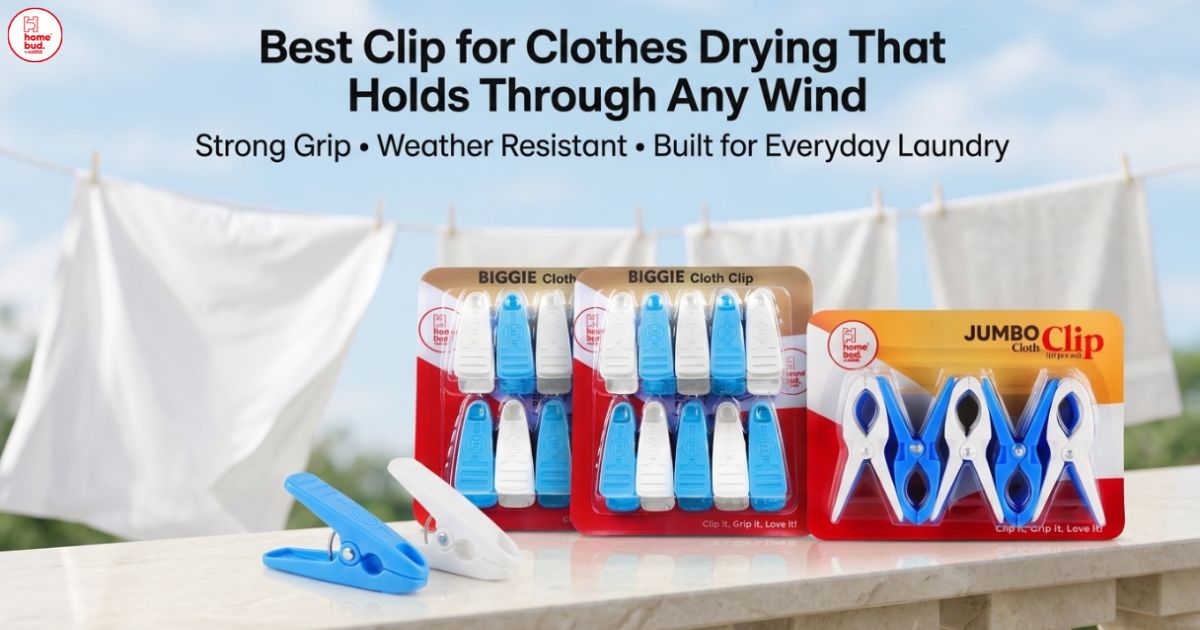
The answer is more than it appears. A clothes drying clip on an outdoor balcony in an Indian household is performing three simultaneous mechanical functions continuously from the moment it is loaded to the moment the laundry is brought in Jumbo Cloth Clip (10 Pcs Set)
.
The first function is vertical load bearing. The clip is holding the weight of the wet garment against gravity through the combined compression of the spring against the rope and the garment fabric. A wet cotton kurta weighs 300 to 400 grams. A wet bath towel weighs 700 to 900 grams. A wet silk saree weighs over one kilogram. The spring must generate enough closing force to grip both the rope and the garment fabric firmly enough to prevent the garment from pulling downward through the clip jaws under this weight.
The second function is lateral wind resistance. When the wind hits a garment hanging on a balcony rope, it exerts a force perpendicular to the direction of the rope — a sideways pull that tries to lift the garment away from the rope and slide or pull it through the clip jaws. The higher the floor, the more exposed the balcony, and the windier the season, the greater this lateral force becomes. During monsoon pre-storm gusts, this lateral force can exceed the vertical weight force by several times.
The third function is mechanical fatigue resistance. Every time you open and close the clip to hang or remove a garment, the plastic hinge and the steel spring experience a small stress cycle. Over hundreds of uses, these accumulated stress cycles cause low-grade materials to develop micro-cracks at the hinge and to lose spring tension. A quality clip is designed to resist this fatigue accumulation across the hundreds of use cycles that months of daily laundry represent.
A clip that manages all three functions consistently over months is a quality clip worth buying. A clip that handles the first function when new and fails progressively on the second and third over weeks is the clip most households are currently using.
1. Homebud Biggie Cloth Clip — Best for Everyday Heavy Laundry Loads
The Homebud Biggie Cloth Clip at Rs. 165 is the everyday workhorse clip for the heavier garments that make up the portion of every Indian family’s laundry load that causes standard clips the most trouble. Bath towels. Denim jeans. Thick cotton kurtas. Heavy winter salwars. Woolen garments. These are the items that standard clips either hold inadequately or snap on within weeks of repeated heavy use because they were sized for lighter garments and are being asked to do more than their design allows.
The Biggie is built with a wider jaw opening that accommodates the thicker fabric layers of heavy garments without being forced past its natural jaw gap. This matters more than most buyers realise. When a clip is forced open wider than its spring mechanism was designed for, the spring is stretched beyond its elastic limit at that moment. Over repeated such uses — every morning bath towel, every denim hang — the spring’s elastic return force decreases progressively. The clip that gripped firmly when new barely holds a cotton t-shirt after a month because the spring has been overstressed repeatedly on garments too heavy and thick for its design.
The wider jaw of the Biggie clips the folded edge of heavy garments at its natural opening position rather than at the forced outer limit of its travel. The spring never approaches its elastic limit during normal use on appropriate garments. The grip force stays consistent across months of daily heavy laundry use because the spring is never degraded by overextension.
The wider jaw also distributes the clamping pressure across more fabric surface area. A narrow standard clip on a thick wet bath towel concentrates all the spring force onto a small fabric contact zone. Over repeated uses, this concentrated pressure can leave visible jaw marks on the towel fabric and can cause thinning of the fabric at the clip contact point over months of daily use. The Biggie’s wider jaw spreads the same spring force across a larger contact zone — adequate grip without concentrated fabric stress.
Rated 4.83 out of 5, the Biggie is the right daily-use clip for any household that regularly dries bath towels, denim, thick ethnic wear, and heavy winter garments alongside the lighter everyday laundry load.
2. Homebud Jumbo Cloth Clip 10 Pcs Set — Best for Sarees, Bedsheets and the Heaviest Items
The Homebud Jumbo Cloth Clip 10 Pcs Set at Rs. 140 is the heavy-duty maximum-strength option built for the laundry items that represent the peak mechanical challenge for any drying clip — full wet sarees, double bedsheets, heavy curtains, thick blankets, and any item where the combined vertical weight and wind-lateral force exceeds what any standard or medium clip can reliably handle.
A full wet silk saree is one kilogram of water-saturated fabric hanging from two to four clip contact points on a balcony rope. The length of a saree means it presents a large surface area to any wind that blows across the balcony — making the lateral wind force proportionally larger than on a shorter garment of the same weight. The clips holding a wet saree in a pre-monsoon gust are experiencing the maximum mechanical load that domestic laundry clips ever face.
The Jumbo clip’s maximum jaw opening handles the folded thickness of saree fabric, bedsheet edges, and curtain tops at the natural opening position of its jaw rather than at the forced extreme. The strongest spring tension in the Homebud range provides the grip force needed to resist both the downward weight and the lateral wind pull simultaneously without the spring yielding.
At Rs. 140 for 10 clips, the Jumbo set provides maximum-strength clips at Rs. 14 each — which is the best value per clip in the Homebud range when measured against the mechanical load capacity delivered. For a household that regularly dries sarees, large bedsheets, and heavy curtains, ten Jumbo clips covers the heavy items in a full laundry load completely.
Rated 4.86 out of 5 and the highest-rated product Biggie Cloth Clip
in the Homebud cloth clip range, the Jumbo is the clip that households with serious laundry demands consistently choose and that delivers the reliable hold-through-anything performance that the heavy laundry category requires.
3. Homebud Standard Cloth Clip 10 Pcs Set — Best for Everyday Light Garments
The Homebud Cloth Clip 10 Pcs Set at Rs. 125 is the everyday standard option for the light to medium weight garments that make up the majority of any household’s daily laundry volume — t-shirts, cotton kurtas, light salwar sets, children’s clothing, socks, handkerchiefs, undergarments, and cotton dupattas.
These garments weigh 150 to 400 grams when wet and are well within the comfortable grip range of the standard clip’s spring tension. The standard clip never approaches its mechanical limits during normal use on these garments, which means its spring maintains consistent tension and its hinge maintains structural integrity for a significantly longer service life than the same clip would have if it were being used on garments that exceed its design load.
Rated 4.83 out of 5, the standard clip is the anchor of any complete household clip collection — the clip you need the most of, in the largest quantity, because it handles the largest volume of the daily laundry load. For a household of three to four people, two to three sets of 10 standard clips covers the everyday light laundry load completely.
4. Heavy Duty Double Spring Clips — Best for Wind Exposed Balconies
For households on high floors, for balconies facing prevailing seasonal wind direction, or for any outdoor drying position that experiences sustained strong wind rather than occasional gusts, a double spring clip design is the engineering answer to the lateral wind force problem.
Standard spring clips use a single steel spring that provides both the jaw closing force and the lateral grip resistance. Under sustained strong wind on a heavy wet garment, a single spring at reduced tension — either from age or from previous overextension on heavy garments — can open slightly under the combined load, allowing the garment to slip through the jaw before the spring recovers its closed position.
A double spring design uses two parallel springs whose combined force is greater than either spring alone. The combined force provides more reliable lateral grip resistance under sustained wind load. It also distributes the mechanical fatigue of repeated use cycles across two springs rather than one, which extends the service life before tension degradation becomes noticeable.
5. Stainless Steel Spring Plastic Clip — Best for Monsoon Season Durability
The steel spring inside a plastic clip is the component most vulnerable to the monsoon season’s combination of sustained humidity, rain contact, and daily wet-dry cycling. A carbon steel spring without protective treatment develops surface corrosion within days of sustained wet monsoon exposure. A corroding spring loses elasticity as the oxidation layer replaces the elastic steel at the spring’s outer surface. The clip progressively loses grip force as corrosion spreads across the spring cross-section.
A stainless steel spring is corrosion-resistant by the nature of its alloy composition — the chromium content in stainless steel forms a passive oxide layer that prevents the deep corrosion that degrades carbon steel springs. A stainless steel spring clip maintains consistent grip force through the full monsoon season without the progressive tension loss that carbon steel spring clips experience as they corrode.
For coastal Indian cities including Mumbai, Chennai, Kochi, and Visakhapatnam where the monsoon season is prolonged and the salt air of proximity to the sea adds a corrosion accelerant to the already humid conditions, stainless steel spring clips are a significant durability upgrade over standard carbon steel spring versions.
6. Mini Clip for Delicate Fabrics — Best for Silk and Fine Fabric Care
Mini clips with a narrower jaw and lighter spring tension are the correct choice for garments where a standard clip’s full spring force would leave visible jaw marks on delicate fabric or where the garment is too small for a standard jaw to grip without the jaw edges extending beyond the garment width.
Fine silk dupattas, georgette blouses, lightweight chiffon tops, and delicate baby clothing all belong on a mini clip. The lighter spring tension of a mini clip provides adequate hold for these lightweight garments in calm to moderate wind conditions without the concentrated clamping force that leaves permanent jaw impressions in fine woven silk or delicate knit fabrics.
For households with significant quantities of fine ethnic fabric in the laundry — silk dupattas, georgette suits, chiffon saree blouses — a dedicated set of mini clips for these garments preserves the fabric condition and the visual presentation of expensive clothes that the wrong clip contact can permanently mark.
7. Colour-Coded Clip Sets — Best for Family Laundry Organisation
Colour-coded clip sets assign a specific colour to each family member's laundry, which makes sorting and returning clothes to the correct wardrobe straightforward without any individual identification effort at the drying line.
For joint family households where multiple family members share a single drying line or drying stand, the visual colour coding removes the sorting ambiguity that slows the bring-in-and-sort step of the laundry routine. Every garment comes inside already identified by owner through its clip colour without requiring anyone to examine each garment individually.
Colour coding also helps when different garment types need different drying durations. Synthetic quick-dry garments can be assigned one colour and identified for early removal without unpacking the entire drying line. Heavy cotton items requiring longer drying get a different colour and stay out until fully dry. The visual system makes drying line management faster and reduces the chances of garments being forgotten outdoors.
8. Pack of 36 Clips — Best for Comprehensive Full-Load Coverage
A single pack of 36 clips in a consistent quality and size gives any household complete coverage for a full laundry load without under-clipping any garment or running short of clips mid-hang.
Under-clipping is one of the most common reasons clips fail in wind. A heavy bedsheet hung on two standard clips — one at each corner — concentrates the entire weight and wind load at two points. The same bedsheet hung on four clips — two per long edge — distributes the load across four points. Each clip is bearing a quarter of the total load rather than half, which means each clip is operating at a fraction of its maximum stress limit rather than near or beyond it. The clips last longer, hold more securely, and the bedsheet is less likely to sag at the centre and drag against other garments or the rope.
The 36-pack format ensures you have enough clips to double-clip every heavy or long garment in the load and still have standard single-clip coverage for all the light items without running short.
9. Windproof Rope Lock Clip — Best for Extreme Wind Conditions
A windproof rope lock clip adds a secondary locking mechanism to the standard spring jaw that prevents the jaw from opening under lateral wind force even when the wind load exceeds what the spring force alone would resist.
The rope lock mechanism grips the rope at a second contact point independent of the spring jaw, which means even if a strong gust momentarily exceeds the spring's grip force, the rope lock prevents the clip from sliding along the rope or rotating open enough to release the garment. For rooftop drying areas, exposed terrace lines, or any drying position that faces extreme seasonal winds, the rope lock clip is the engineering solution that handles conditions beyond the performance envelope of standard spring clips.
10. Bamboo or Wooden Eco Clip — Best for Sustainable Households
Bamboo or wooden pegs are the traditional Indian laundry clip — the clip that households used before plastic became dominant. Natural wood and bamboo clips are fully biodegradable, free from plastic waste, and made from renewable materials.
The trade-off in Indian conditions is moisture vulnerability. Wooden clips absorb water in the humid Indian monsoon, which causes the wood to swell slightly at the hinge joint and the spring to rust. Over a monsoon season of daily wet use, wooden clips develop the looseness at the hinge and the reduced spring tension that makes them less effective for heavy wet garments than at the start of the season.
For households prioritising sustainability, bamboo clips made with a stainless steel spring — rather than a standard carbon steel spring — address the rust problem and extend the service life of the eco clip through monsoon season conditions. For light everyday garments in moderate weather conditions, standard bamboo or wooden clips perform adequately and biodegrade cleanly at the end of their life.
The Complete Clip System for an Indian Household
The most effective household clip system uses multiple clip sizes matched to garment weight categories rather than a single clip type for everything.
Standard Cloth Clips for everyday light garments — t-shirts, cotton everyday wear, children's clothing, socks, undergarments, and light ethnic tops. Two to three sets of 10 covers a full family daily light laundry load.
Biggie Cloth Clips for medium-heavy everyday items — bath towels, denim jeans, thick cotton ethnic wear, and winter woolens. One set of Biggie clips alongside the standard set covers these items correctly.
Jumbo Cloth Clips for the heaviest items — full sarees, double bedsheets, large curtains, and heavy blankets. One 10-piece Jumbo set handles the heavy items in any household laundry load at maximum grip security.
This three-tier system costs Rs. 125 plus Rs. 165 plus Rs. 140, totalling Rs. 430 for a complete clip collection across all three size categories. This is the one-time investment that ends the monthly replacement cycle of cheap clips that keep failing.
Browse all three Homebud cloth clip options and build your complete laundry drying system at homebud.in/product-category/cloth-clip/ with free shipping on every order and a surprise gift included.
How to Get the Most Life from Your Clothes Drying Clips
Bring clips inside between laundry sessions rather than leaving them permanently on the outdoor rope. Clips left outdoors receive continuous UV degradation from direct sun, sustained humidity contact in monsoon conditions, and the temperature cycling from hot midday sun to cool rainy afternoons. Clips stored inside between uses receive a fraction of this cumulative environmental stress and last considerably longer.
Test spring tension monthly. Open the clip fully and release it. A healthy spring snaps the clip back to fully closed immediately with a firm return. A degrading spring closes slowly or returns to only partially closed. Replace clips that show degraded tension before they fail on a heavy garment in wind — catching spring degradation early prevents the laundry on the floor scenario rather than responding to it.
Use two clips on every long or heavy garment. A single clip on a heavy wet saree or bedsheet bears the full weight at one point. Two clips on the same garment share the load between them, halving the stress on each clip and halving the probability of either clip failing. Double-clipping heavy items is the single most effective technique for preventing clips from failing on exactly the items where clip failure causes the most inconvenience.
Store clips in a dry container rather than leaving them in an outdoor bag or bucket between laundry sessions. A dry storage container prevents the spring from being in continuous damp contact between uses, which is the primary cause of spring corrosion even in stainless steel springs over a long enough period in sustained monsoon conditions.
FAQ on Clip for Clothes Drying
The Homebud Jumbo Cloth Clip at Rs. 140 for 10 pieces is specifically designed for this use case. Its maximum jaw opening handles the folded thickness of saree fabric naturally and its strongest spring tension in the Homebud range provides the grip force needed to hold a wet saree through pre-monsoon and monsoon wind loads. Always use two Jumbo clips per saree — one at the starting border and one at the pallu end — to distribute the weight across two clip contact points.
Hinge snapping is caused by using a clip on garments heavier than its design load capacity. Each use on an overweight garment stresses the hinge plastic beyond its elastic limit. Over repeated such uses, micro-cracks develop at the hinge until the plastic snaps during normal opening. Use the Biggie clip for medium-heavy garments and the Jumbo clip for the heaviest items to keep every clip operating within its design load range.
A family of four with daily laundry needs 35 to 50 clips across three size categories. Two sets of the standard Cloth Clip 10 Pcs for everyday light garments, one to two Biggie clips for towels and heavy items, and one set of Jumbo clips for sarees and bedsheets provides complete coverage for all garment weight categories without any clip being overloaded.
No. Bringing clips inside between laundry sessions significantly extends their life by reducing cumulative UV exposure, monsoon moisture contact, and temperature cycling degradation. Clips stored inside maintain their plastic integrity and spring tension considerably longer than clips left permanently outdoors.
The Biggie is designed for medium-heavy everyday items — bath towels, denim jeans, and thick cotton garments in the 500 to 900 gram wet weight range. The Jumbo is designed for the heaviest laundry items — full sarees, double bedsheets, blankets — in the one kilogram and above wet weight range. Both are stronger than the standard clip but calibrated for different garment weight categories.
All three Homebud cloth clip options are available at homebud.in/product-category/cloth-clip/ with free shipping across India and a surprise gift on every order.