
Shirt Hangers Every Wardrobe Needs for a Clean Look
-
Posted by
homebud
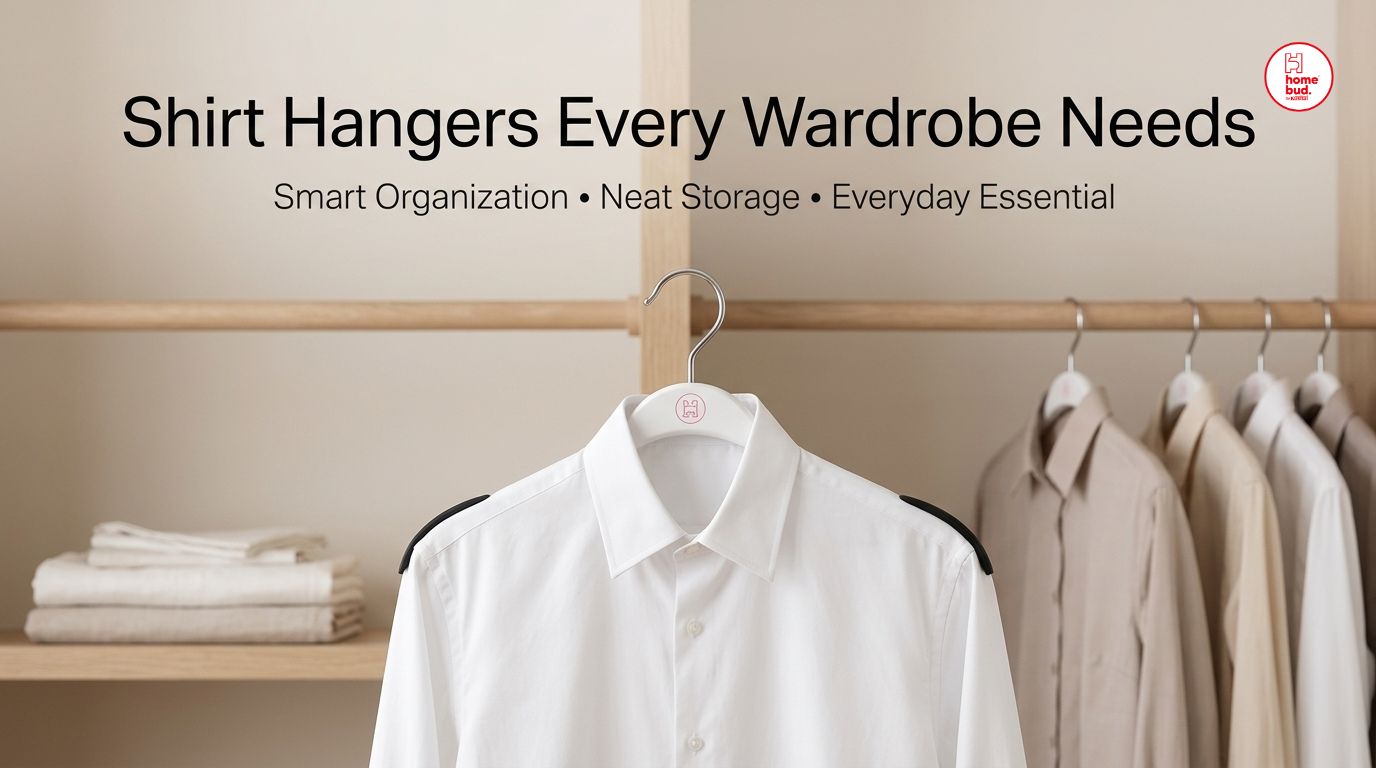
Walk up to a wardrobe that has the best shirt hangers inside it and the difference is visible before you even reach in. Every shirt is at the same height. Every shoulder is supported at the right width. Nothing is sliding, bunching, or developing that mysterious crease across the back that appears overnight and takes twenty minutes to iron out. The wardrobe looks like it belongs to someone who has their life together.
Now walk up to the average wardrobe in the average Indian home. Wire hangers from the dry cleaner still holding shirts from three months ago. Thick plastic hangers mixed with thin ones so every shirt hangs at a slightly different height. A couple of garments that have slipped to one side because the hanger shoulder was too smooth to grip a cotton kurta with a wide neckline. And somewhere at the back, a shirt that has developed that permanent shoulder bump from a hanger that was too narrow for its collar.
The hanger is not a minor detail in wardrobe organisation. It is the foundation. Every shirt you hang is shaped by the hanger holding it. Every morning you open the wardrobe is either easy or frustrating based on how the hangers inside are doing their job. And the investment in the right hangers — the ones that actually fit your shirts, protect your fabric, save your wardrobe space, and hold their position reliably — is one of the most cost-effective wardrobe decisions you can make.
What Makes a Shirt Hanger Worth Buying
Most buyers choose hangers based on price or appearance without knowing the functional criteria that determine whether a hanger actually does its job properly. Here is what matters.
Shoulder span is the most important dimension of any shirt hanger. A hanger whose shoulder span matches the shoulder width of the shirt hangs the garment in its natural shape. The shoulder seam sits at the edge of the hanger shoulder, the shirt hangs straight, and the collar sits correctly at the hook. A hanger that is too narrow for the shirt creates a bunching fold at the collar and puts the shirt’s shoulder seam under constant lateral compression — which over weeks of hanging causes the seam to pull inward and the fabric at the back collar to develop a persistent fold that ironing only temporarily resolves.
Anti-slip surface determines whether a shirt stays where you hang it or slowly migrates to one side of the hanger until it falls off. Shirts with wider necklines — kurtas, crew necks, casual cotton shirts with loose collars — slide off smooth plastic shoulders progressively. An anti-slip textured or coated shoulder keeps the garment positioned correctly from the moment you hang it until the moment you take it off.
Hook quality determines how the hanger sits on the wardrobe rod and whether it can be added or removed smoothly without catching and dragging adjacent hangers out with it. A hook that sits straight on the rod at the correct angle allows smooth individual removal. A hook that tilts forward or backward on the rod pushes adjacent hangers at an angle and wastes rod space.
Plastic quality and structural rigidity determines how long the hanger maintains its shape under the weight of the garments it holds. A hanger that bends slightly at the centre under a heavy kurta or a blazer puts the garment’s centre back under a permanent downward tension that creates a fold line. A rigid hanger that maintains its flat form holds every garment in the correct shape regardless of weight.
Thickness determines how many shirts you can fit on your wardrobe rod. Slim hangers fit more garments in the same rod length. A shift from thick standard hangers to slim profile hangers on a 90 cm rod can increase the number of garments hanging comfortably by 60 to 70 percent without any change to the wardrobe itself.
1. Homebud Dashing Hanger 5 Pcs Set — Best Everyday Shirt Hanger for Indian Wardrobes
The Dashing Hanger 5 Pcs Set at Rs. 350 is the best everyday shirt hanger for the daily-use section of any Indian wardrobe. It is built with a lightweight but strong plastic body that holds its rigid flat form under the weight of standard everyday garments — shirts, kurtas, t-shirts, formal tops, casual cotton wear — without any centre bending that would distort the garment’s hang.
The anti-slip design keeps clothes neat and wrinkle-free by holding the shirt in its placed position on the hanger shoulder rather than allowing it to slide over hours. This anti-slip property is particularly valuable for everyday cotton shirts and kurtas with slightly wider or rounded necklines that slide off smooth plastic shoulders on cheap hangers, and for synthetic fabric tops that are even more prone to slipping because the fabric surface has less natural friction than cotton.
The slim profile of the Dashing Hanger saves rod space compared to thick plastic hangers. On a standard Indian almirah rod of 80 cm, replacing standard-thickness hangers with Dashing Hangers can increase the number of shirts hanging comfortably from approximately 12 to 15 shirts to 20 to 22 shirts — a difference that is immediately visible and that solves the overcrowded rod problem that most Indian wardrobes face without any additional storage furniture.
The hook is engineered for smooth rotation on standard wardrobe rods, which means pulling one shirt out in the morning does not drag three adjacent shirts out with it. This single daily quality-of-life improvement makes every morning wardrobe interaction more pleasant and faster.
Rated 4.83 out of 5, the Dashing Hanger is the highest-rated hanger in the Homebud range and the one most buyers return to purchase in additional sets after experiencing the difference it makes to their wardrobe. At Rs. 350 for 5 hangers, the investment covers the everyday wear section of one person’s wardrobe and can be scaled with multiple sets to cover the complete wardrobe in a single order.
2. Homebud Kids Hanger 5 Pcs Set — Best Shirt Hanger for Children's Clothes
The Kids Hanger 5 Pcs Set at Rs. 275 is the correctly sized shirt hanger for baby clothing, toddler garments, and children’s everyday wear. This is the hanger that most parents skip buying and then spend months dealing with the consequences of using adult hangers on children’s clothing.
An adult shirt hanger has a shoulder span of approximately 40 to 44 cm — the correct width for adult shoulder seams. A child’s t-shirt or school shirt has a shoulder span of 22 to 30 cm depending on the child’s age. When a children’s shirt is hung on an adult hanger, the shirt’s shoulder seams are stretched outward by 10 to 20 cm across a hanger that is far too wide. The fabric at the shoulder seams experiences constant lateral tension for every hour the shirt is hanging. Over days and weeks, this distorts the seam position, stretches the fabric at the shoulder, and deforms the shape of the collar and neckline in ways that are visible when the child wears the garment.
The Kids Hanger is sized for the actual shoulder span of baby and children’s clothing. The slip-resistant arms hold small garments in position without the wide necklines of children’s casual tops sliding off the shoulders of the hanger during the night. The smooth finish protects delicate baby fabric from the snagging that a rough or seamed plastic surface causes on fine cotton muslin, soft knit, and delicate children’s fabrics.
For parents managing a children’s wardrobe alongside their own, a set of Kids Hangers for the children’s section creates the same uniform, organised appearance that adult hangers create for the adult section — with the additional functional benefit of properly maintaining the shape of clothing that growing children need to fit correctly every time they wear it.
At Rs. 275 for 5 hangers, the Kids Hanger is the wardrobe investment that protects the clothing investment parents make in quality children’s garments.
3. Heavy Duty Plastic Shirt Hanger — Best for Blazers and Heavy Formal Wear
For the formal section of a wardrobe — blazers, suit jackets, sherwanis, and heavy ethnic formal wear — a wider-shouldered heavy duty plastic hanger with a broader frame is the right choice over a slim everyday hanger. The wider frame supports the structured shoulder panels of tailored formal wear in their intended shape, which is important for garments where the shoulder structure is a defining design element that collapses inward when hung on a hanger too narrow for the garment.
A slim hanger under a blazer allows the shoulder panels to hang unsupported on either side of the hanger shoulders, which causes them to fold slightly inward under gravity. After weeks of storage on an inappropriately narrow hanger, tailored blazer shoulders develop a rounded inward curve that requires steaming to restore. A wide-shouldered heavy duty hanger prevents this entirely by supporting the full breadth of the blazer shoulder across the hanger frame.
4. Velvet Shirt Hanger — Best for Preventing Slip on Delicate Fabrics
Velvet-coated shirt hangers use a thin velvet covering over a slim plastic core that provides maximum anti-slip surface for the most slip-prone garment types. Silk shirts, georgette tops, satin blouses, and lightweight synthetic fabric garments that slide off every other hanger material — including anti-slip plastic — typically stay in place on a velvet hanger because the velvet pile creates multi-directional friction against the fabric surface.
For a wardrobe that includes significant quantities of silk or lightweight synthetic garments alongside everyday cotton wear, a dedicated set of velvet hangers for the slippery garment category solves the sliding problem at the source rather than requiring constant repositioning.
5. Wooden Shirt Hanger — Best for Premium Formal and Heritage Garments
Wooden hangers are the traditional premium choice for formal garment storage and for clothing that is kept long-term rather than worn regularly. The weight and rigidity of a quality wooden hanger provides excellent support for heavy formal wear. The natural material breathes slightly, which is beneficial for silk and natural fibre garments in long-term storage. And the aesthetic of wooden hangers in the wardrobe creates the most premium visual presentation of any hanger type.
The trade-off is weight and rod space. Wooden hangers are significantly heavier than plastic and take more rod space per hanger than slim plastic options. They are the right choice for the premium or occasional-wear section of a large wardrobe rather than for the high-density everyday wear section where slim plastic hangers are more practical.
6. Multi-Tier Shirt Hanger — Best for Small Wardrobes with Many Shirts
A multi-tier shirt hanger uses a cascading design where multiple shirt loops hang from a single hook position on the rod, allowing three to five shirts to occupy the rod space of a single hanger. For wardrobes where every centimetre of rod space is at a premium — a single person in a studio apartment, a child sharing wardrobe space with siblings, or a compact room almirah with a short rod — the multi-tier hanger dramatically increases the number of garments that can be hung without any additional wardrobe space.
The trade-off is accessibility. Removing the third shirt in a five-shirt cascade requires removing the first two. For garments worn daily, a standard single-shirt slim hanger is more practical. For occasional-wear shirts, seasonal items, or overflow storage, multi-tier hangers are an efficient space solution.
How to Choose the Right Shirt Hanger for Your Wardrobe
The decision comes down to three questions. What garments are you hanging. How much rod space do you have. And what is the visual and organisational result you want.
For everyday shirts, kurtas, and casual tops that form the daily-use core of any Indian wardrobe, the anti-slip slim profile of the Dashing Hanger 5 Pcs Set delivers the best combination of garment protection, rod space efficiency, and consistent anti-slip performance. For children’s clothing in any household with kids, the Kids Hanger 5 Pcs Set is the non-negotiable correct choice for protecting small garment shapes and seams.
For formal and heavy ethnic wear, a wider shoulder span hanger maintains tailored garment structure. For delicate silk and synthetic fabrics, velvet-coated provides the best anti-slip surface. And for any household doing a full wardrobe upgrade to a uniform consistent hanger set, buying in sets of 5 from the Homebud hanger range and combining types to cover all garment categories in a single order is the most efficient approach.
Browse the complete Homebud hanger range at homebud.in/product-category/hanger/ and find the right combination of hangers for every garment in your wardrobe.
FAQ on the Best Shirt Hangers
For standard adult shirts and kurtas, a hanger with a shoulder span of 40 to 44 cm fits the shoulder seams of most adult garments correctly without overstretching or bunching. The Dashing Hanger is sized for this standard adult garment range and works correctly for men's shirts, women's tops, kurtas, and casual shirts of standard adult sizing.
Shoulder bumps develop when a hanger is too narrow for the garment and the fabric above the hanger shoulder edge is pushed upward into a rounded bump by the edge of the hanger. Using a hanger with the correct shoulder span for the garment prevents this. The bump is most visible on fine knit fabrics and lightweight synthetic tops and can be steamed out but recurs if the garment continues to be hung on the wrong size hanger.
No. Adult hangers are significantly wider than children's shoulder spans and stretch the shoulder seams and neckline of children's clothing outward during storage. The Kids Hanger 5 Pcs Set at Rs. 275 is correctly sized for baby and children's garments and protects the shape and seams of these smaller clothes properly.
Count the garments currently hanging in your wardrobe and add 20 percent for new purchases. A single adult wardrobe with everyday and occasional wear typically needs 20 to 30 hangers. A family wardrobe for two adults and two children needs 50 to 70 hangers across adult and kids sizes. Buying multiple sets of the Dashing Hanger for adults and Kids Hanger for children in a single order covers the complete household need efficiently.