
Best Cloth Clip to Keep Your Laundry Secure Always
-
Posted by
homebud
There is a particular sound every Indian household knows. The flat, wet slap of a bedsheet hitting the balcony floor.
You hung it out an hour ago. The wind picked up around four. And now the sheet you washed this morning is lying on the tiles, collecting dust, folded into a puddle from yesterday’s rain that never dried in the corner. Somewhere below, a neighbour is complaining that a kurta has landed on their car.
Nobody blames the clip. We blame the wind, the balcony, the weather. But the clip is exactly where the failure happened — and it is the cheapest thing in the entire chain to fix.
A good cloth clip is a ₹10 object that protects a ₹2,000 saree, saves you a re-wash, and keeps you from leaning over a railing to see where your laundry went. This guide covers what actually separates a clip that holds from one that gives up in four months, which type suits which fabric, and how to build a clip set that handles everything your household throws at the line.
Why Most Cloth Clips Fail Within a Few Months
Walk into any general store and you will find clips at three price points that look nearly identical. They are not. Failure almost always traces back to one of four causes.
The spring loses its tension. This is the most common failure. Low-grade steel springs, or springs made too thin to save material cost, gradually lose their return force. The clip still closes — it just does not close hard enough. You will not notice it happening. You will notice it the day a towel goes down.
The plastic turns brittle in the sun. Ordinary plastic that has not been UV-stabilised chalks, fades and cracks under direct Indian sunlight. Clips live outdoors, in full sun, every day. A clip that snaps at the hinge when you press it has been dying slowly for six months.
The spring rusts. Uncoated or poorly coated steel exposed to monsoon humidity and coastal air corrodes. A rusted spring does two things: it seizes, and it transfers orange stains onto white clothes. That stain is often permanent.
The jaw is too small for the job. A narrow, shallow jaw cannot grip the thick hem of a bedsheet or a wet double-layer of denim. It slides. People compensate by using three clips where one should do, which just multiplies the number of weak points.
Every one of these is a material and design problem, decided before the clip ever reached the shop. Which is why buying better once solves it permanently.
What Makes a Cloth Clip Actually Good
Here is what to check, in order of how much it matters:
- Spring strength and recovery — the clip should snap shut with authority and keep doing so after thousands of cycles, not just on day one
- Rust-resistant spring material — stainless or properly coated steel, because a rusted spring stains clothes and seizes shut
- UV-stabilised body — the difference between a clip that lasts four years in Indian sun and one that goes brittle in one summer
- Wide, ridged gripping jaws — ridges create friction so the clip holds without needing to bite harder, which is what prevents fabric marks
- A generous mouth opening — thick hems, folded bedsheets, blanket edges and wet denim all need jaw clearance most cheap clips do not have
- Smooth, rounded contact edges — sharp jaw edges are what leave those little dents on collars and delicate fabric
- Balanced weight — heavy enough to be stable on the line, light enough not to drag a lightweight dupatta down
- A hinge that does not wobble — side play in the pivot means uneven pressure and slippage under load
The single most useful test in a shop takes three seconds: press the clip open fully and let it go. It should close sharply, with a firm sound, and the jaws should meet flat against each other with no gap and no side movement. That one test filters out most of what fails.
The Indian Balcony Problem Nobody Designs For
Most laundry accessories are designed for temperate conditions and mild sun. Indian drying conditions are considerably harsher, and the clip has to survive all of it:
Peak summer sun at 45°C on a west-facing balcony. Monsoon humidity that keeps everything damp for weeks. Coastal salt air in Mumbai, Chennai, Kochi and Goa. Dust and grit in Delhi and across the north. And on the eleventh floor of an apartment building, sustained wind speeds that a ground-floor courtyard never sees.
High-rise wind deserves special mention because it is a genuinely different problem. A clip that works perfectly in an independent house’s backyard may be entirely inadequate on a tower balcony where gusts are funnelled between buildings and accelerate. If you live above the sixth floor, you need clips rated by grip strength, not by price.
This is the context the Homebud cloth clip range is built for — real balconies, real monsoons and real wind, not showroom conditions.
Matching the Right Clip to the Right Fabric
Not every garment needs the same grip. Using one clip type for everything is why people end up with both fallen laundry and marked collars.
- Bedsheets, blankets and towels — the heaviest, wettest, most wind-catching items. These need maximum spring force and a wide jaw. This is where standard clips fail most often
- Jeans and heavy cotton — when wet, denim can hold two to three times its dry weight. Grip strength matters more than gentleness here
- Sarees and dupattas — light fabric, but enormous surface area, which makes them the most wind-sensitive item on any line. Use more clips spaced closer together rather than fewer strong ones
- Woollens and knits — never hang by the shoulders with clips; they stretch. Fold over the line and clip the folded edge to distribute weight
- Shirts and formal wear — clip at the side seam or hem, not the collar or shoulder, so any pressure mark falls where nobody sees it
- Delicates and innerwear — light grip, smooth jaws, and if possible clip through a fold of fabric rather than a single layer
- Curtains and large covers — heavy and wide. These need the same treatment as bedsheets
The practical rule: heavy or wet means strong grip and wide jaws; light and wide means more clips, spaced evenly.
Choosing Between the Biggie and the Jumbo Set
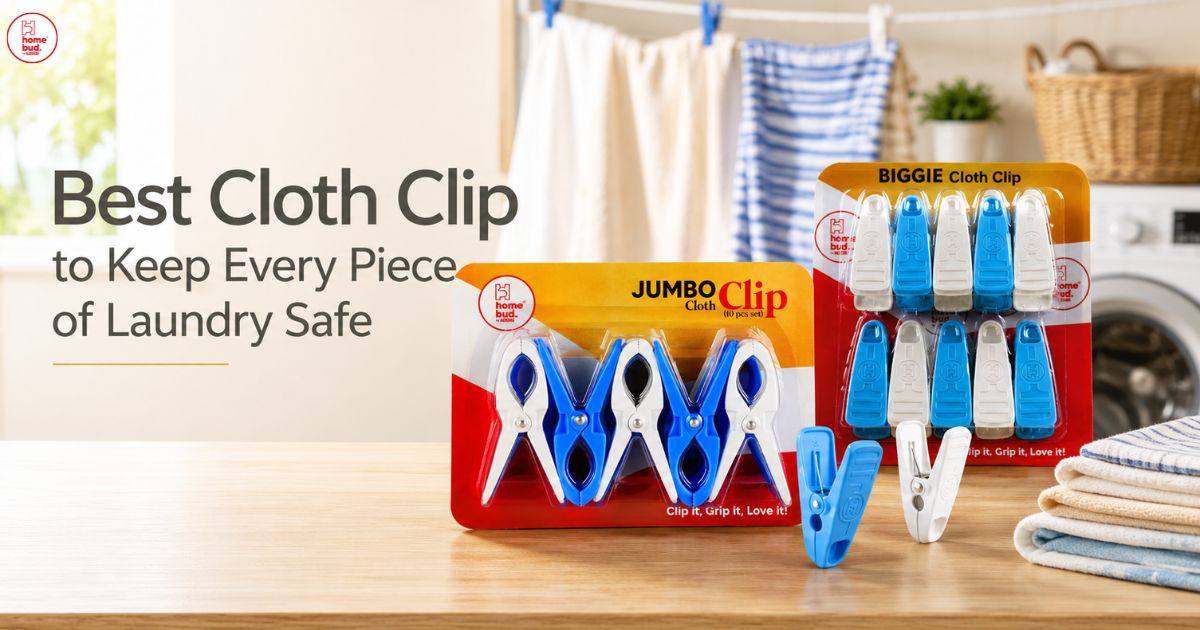
For the heavy end of your laundry — double bedsheets, blankets, thick bath towels, quilt covers and wet denim — the Biggie Cloth Clip is built specifically for load. The larger jaw opening takes a folded bedsheet hem that standard clips simply cannot accommodate, and the stronger spring keeps that grip through a full drying cycle in wind. If your current clips slip on heavy items, this is the piece that fixes it.
For everything else, buying in a set is the sensible route. The Jumbo Cloth Clip (10 Pcs Set) covers a full household load in one purchase — enough to hang a family’s daily wash without rationing clips or resorting to the three-broken-ones-in-the-drawer approach. Ten pieces is also roughly the point where you stop running out mid-load, which is when people start hanging things carelessly and losing them.
Most households are best served by both: a set of Jumbos for daily volume and a few Biggies reserved for the heavy items.
How Many Clips Do You Actually Need?
More than you own. That is almost always the answer.
A rough working calculation: count the number of items in one typical wash load, then allow two clips per item for shirts and light garments and four to six for bedsheets and heavy items. For a family of four running a load every day, that lands somewhere between 20 and 30 clips in active use, before accounting for the ones that inevitably disappear over the railing.
Under-buying clips is a false economy in the most literal sense. When you run short, you hang the last three items with one clip each, and those are the three items that end up on the floor.
Cloth Clips Do More Than Laundry
Once you have good clips in the house, they migrate. Almost every household finds these uses within a month:
- Sealing snack packets — chips, namkeen, bread bags, biscuit packets and opened masala pouches
- Holding curtains back or clipping temporary curtains to a rod
- Securing table covers on windy terraces and during outdoor functions
- Bundling cables and wires behind desks and TV units
- Kitchen towels clipped to a rail or handle so they stay put
- Travel — clipping a hotel curtain shut, holding a bag closed, drying laundry on the go
- Children's craft and drawings clipped to a string across a wall
- Keeping a recipe or shopping list visible and upright while you cook
None of these are reasons to buy clips. But they are reasons to buy clips that do not crack, because the ones that end up in the kitchen tend to be the ones that survived the balcony.
Making Your Clips Last Longer
Good clips last for years, and a few small habits stretch that further:
- Store them out of direct sun when not in use — a small basket or bag near the line does more for lifespan than anything else
- Rinse and dry after heavy monsoon exposure — particularly in coastal areas where salt accelerates spring corrosion
- Do not over-stretch the jaws — forcing a clip past its designed opening to fit an over-thick bundle is the fastest way to kill a spring
- Clip at hems and seams — double-layered fabric takes pressure better and marks less than a single layer
- Check clips seasonally — press-test the whole set once before summer and once after the monsoon and discard the weak ones instead of discovering them mid-load
- Keep rusted clips away from white clothes — the moment you see corrosion, retire that clip from laundry duty entirely
The Cost Nobody Calculates
Cheap clips at ₹3 to ₹5 a piece feel like the economical choice. Most households replace them twice a year, which over five years is ten replacement cycles for a 20-clip set.
Quality clips cost more per piece and routinely last three to five years or longer. Across the same five years, that is one purchase against ten.
But the replacement cost is the smaller number. The real cost is a saree that fell into a wet balcony corner and had to go to the dry cleaner, a shirt with a rust stain that will not come out, a bedsheet re-washed for the third time, and the twenty minutes spent going downstairs to retrieve a towel from a stranger's parking spot. Set against that, the price difference between a good clip and a bad one stops being a consideration at all.
Small Purchase, Permanent Fix
The wind is not going to stop. The balcony is not going to change. The only variable you actually control is the thing holding the fabric to the line.
Buy clips that grip properly once, and the entire problem disappears quietly — no fallen bedsheets, no rust stains, no re-washing, no going downstairs to look for a kurta.
Browse the full Homebud cloth clip range and pick the grip strength your laundry actually needs.
Frequently Asked Questions
Use enough clips — two per light garment, four to six across a bedsheet — and place them at hems and seams where the fabric is doubled. On high-floor balconies, choose clips rated for stronger grip rather than adding more weak ones.
Well-designed clips with smooth, rounded, ridged jaws distribute pressure and do not mark. Marks come from sharp jaw edges, excessive point pressure, and clipping delicate single-layer fabric. Clipping at hems and seams eliminates the problem almost entirely.
A wide-jaw, high-tension clip like the Biggie. Standard clips lack both the mouth opening for a folded thick hem and the spring force to hold wet weight through a windy afternoon.
Quality clips use rust-resistant spring material and hold up through wet seasons. Cheap uncoated springs corrode and then stain clothes orange — which is why a rusted clip should be removed from laundry use immediately.
Around 20 to 30 in active use. A 10-piece set is a sensible starting unit, and most households find two sets plus a few heavy-duty clips covers daily laundry comfortably.
Yes, with the right technique. Use more clips spaced closer together, clip through a fold rather than a single layer, and choose clips with smooth jaws. Sarees fail on the line because of surface area catching wind, not clip strength.
Three to five years of daily outdoor use is a fair expectation from a UV-stabilised body with a quality spring. Poor-quality clips typically last six to twelve months.
Almost always. Sets cost less per piece and, more importantly, mean you never run short mid-load — which is exactly when clothes get hung carelessly and lost.